
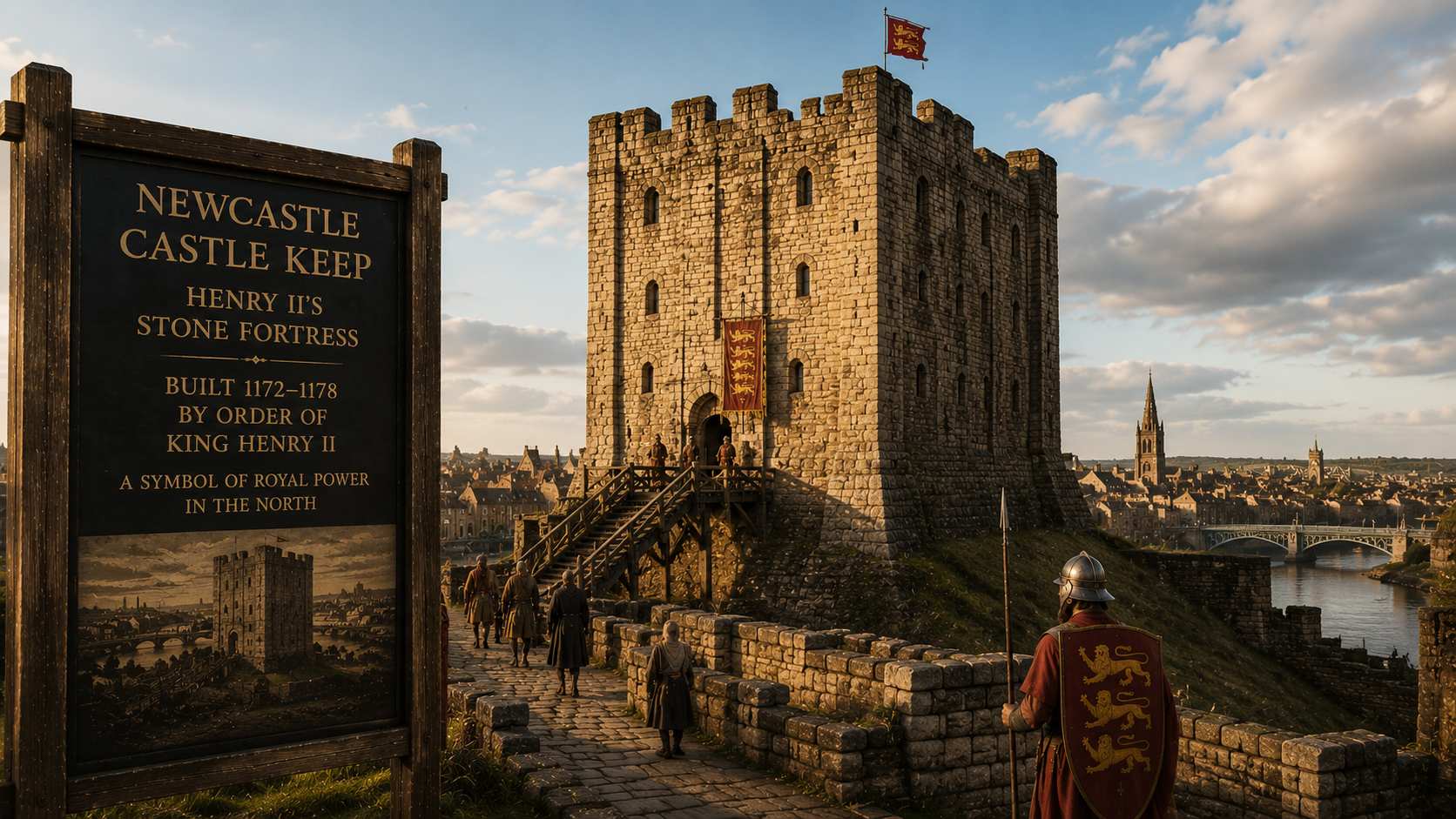
Every city has an origin story, but few wear it as plainly as Newcastle. The "New Castle" that gave the city its name still stands, in stone, in the middle of town — even if what visitors see today is not quite the fortress that started it all.
Robert Curthose's Wooden Beginning
The story starts in 1080, when Robert Curthose, eldest son of William the Conqueror, was sent north to campaign against the Scots. Returning from that expedition, he ordered a fortification built on high ground above the Tyne, on a site that had previously carried an Anglo-Saxon cemetery and, centuries earlier still, the Roman fort of Pons Aelius. Curthose's structure was a timber motte-and-bailey castle: a wooden tower on an earthen mound, ringed by a ditch and a stockaded outer courtyard.
This was the original "New Castle upon Tyne", and the name stuck to the settlement that grew up around it long after the timber structure itself was gone. In 1095, the castle passed into direct royal control after Robert de Mowbray's rebellion against William Rufus was crushed, cementing its role as a crown stronghold used to keep watch over the often unruly northern barons.
Henry II Builds in Stone
Nothing of Curthose's wooden castle survives today. Between 1172 and 1177, Henry II replaced it entirely with a rectangular stone keep, a project that cost an eye-watering £1,444 at the time. The new keep was designed as both a defensive stronghold and an unmistakable statement of royal authority in a part of the kingdom that had spent much of the previous century contested between English and Scottish rule.
The keep that resulted, roughly 19 by 17 metres in plan, remains one of the best-preserved Norman keeps in the country, with walls reported to be some thirteen feet thick in places. Seventy years later, Henry III added a further layer of defence: a fortified gatehouse to the north of the keep, built between 1247 and 1250, which became known as the Black Gate. A 75-foot gap between the two structures — later filled almost entirely by a Victorian railway viaduct — marks where the medieval bailey once stood.
A Castle Outside the Walls
One curious detail often surprises visitors: when Newcastle's town wall was built in the following century, starting around 1265, it did not actually enclose the Castle Keep and Black Gate. The castle predated the wall by nearly a century, and by the time the town's defences were extended, the castle already stood as an independent royal stronghold rather than a component of the town's own fortifications, a reminder that castle and town, though intertwined in name, were never quite the same institution.
The Keep's long life after its military usefulness faded is almost as colourful as its construction. Records describe the building falling into serious disrepair over the following centuries: by the time antiquarian Henry Bourne wrote his history of Newcastle in 1736, the Keep was roofless with its floors collapsed, save for one level that had come to serve as the roof of a gaol in the basement below. In the late 18th century, parts of the ageing structure were put to remarkably unglamorous uses — the old chapel served for a time as a beer cellar for a nearby pub, another section held an ice house, and the top of the walls reportedly supported a cabbage garden.
A Restored Landmark
The Keep's fortunes turned in the 19th century, when restoration work began to return the structure to something closer to its medieval form. Today it stands as a Grade I listed building and Scheduled Ancient Monument, and one of the most complete surviving examples of Norman military architecture in Britain, open to visitors who can climb through its restored interior and reach the rooftop for sweeping views over the Tyne.
What makes Newcastle Castle worth understanding, beyond its architecture, is the sheer continuity of the site itself. Roman fort, Anglo-Saxon cemetery, Norman timber castle, Angevin stone keep, medieval prison, Georgian curiosity, restored monument: nearly two thousand years of use are stacked on this one small patch of ground above the river, and the stone keep that survives today is only the most visible layer of a much longer story that gave the entire city its name.