
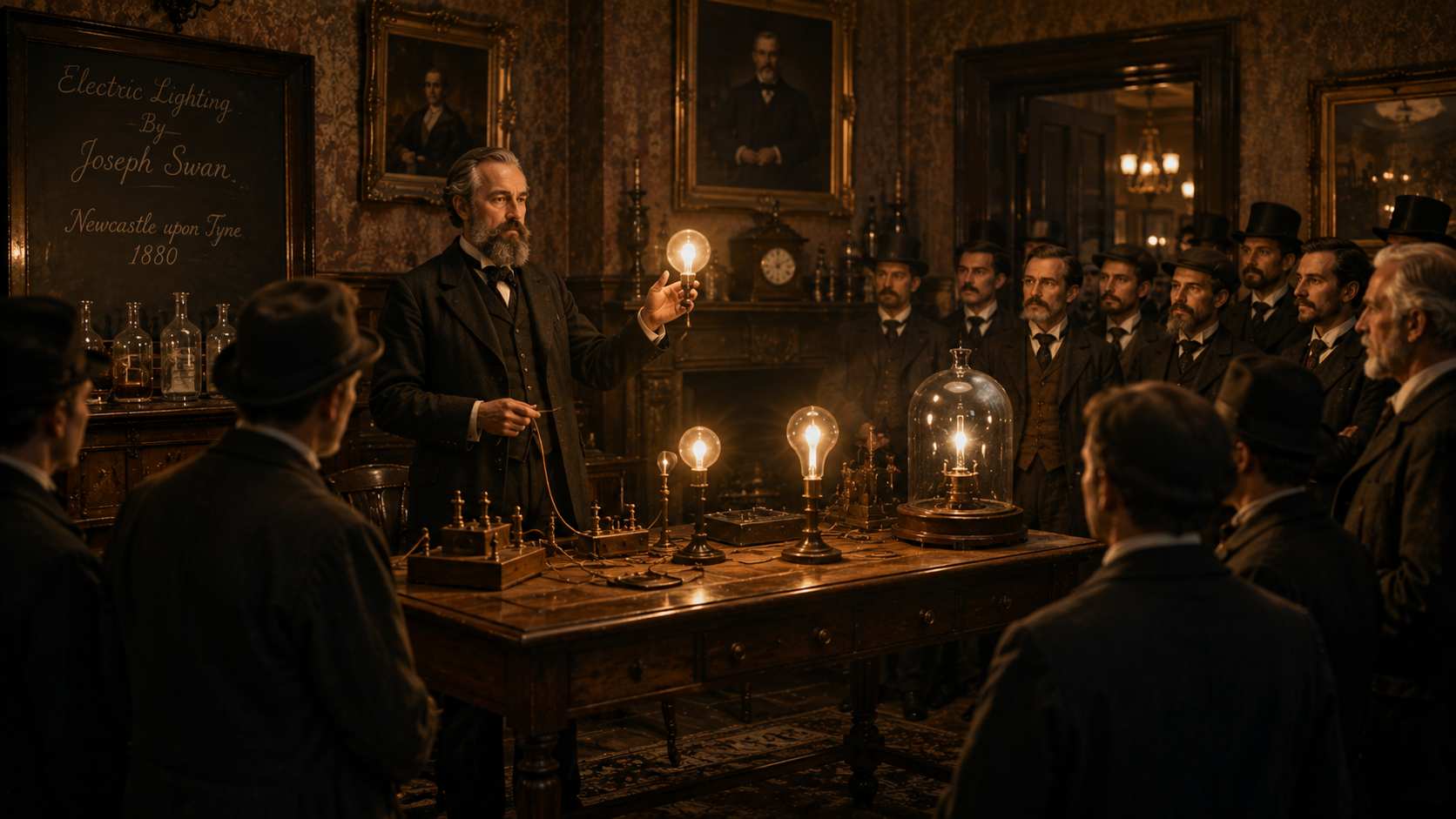
Ask most people who invented the light bulb, and the answer will almost certainly be Thomas Edison. Ask in Newcastle, and you will get a different, better-supported answer: Joseph Swan, a local chemist whose public demonstrations in the city predate Edison's own famous breakthrough by the best part of a year.
A Lamp That Burned for Minutes, Then Months
Swan's first public demonstration of a working incandescent lamp took place on 18 December 1878, at a lecture given to the Newcastle upon Tyne Chemical Society. The lamp, using a carbon filament inside a glass vacuum, glowed brightly for several minutes before burning out under excessive current, an imperfect but genuine proof of concept. Swan returned to the same lecture series on 17 January 1879 with a significantly improved version, one that ran successfully for the entire duration of the lecture without failing.
Encouraged by that success, Swan staged a considerably larger public demonstration on 3 February 1879, presenting his working lamp to an audience of more than seven hundred people in the lecture theatre of the Literary and Philosophical Society of Newcastle upon Tyne, with none other than Sir William Armstrong, Newcastle's own engineering titan, presiding over the event. For the crowd gathered that evening, watching an electric lamp glow steadily without any flame or gas at all, this was something close to witnessing the future arrive in real time.
The First Room in the World
Swan spent the following months refining his design further, developing a method of treating cotton thread to create what he called "parchmentised" carbon filaments, a significant improvement that would eventually earn him a British patent in November 1880. Before that patent was granted, though, Swan achieved a milestone with even greater symbolic significance for his home city: on 20 October 1880, his lamps were used to light the Lit and Phil's own premises on Westgate Road during one of his lectures there, making it the first public room anywhere in the world illuminated entirely by electric light bulbs.
That achievement placed Newcastle, however briefly, at the absolute cutting edge of a technology about to transform the entire world. While gas lighting still dominated public buildings across Britain and beyond, a lecture theatre in Newcastle had already made the leap to electric illumination, powered by lamps invented, tested and perfected by a man who had spent years working through the technical challenges in laboratories and workshops across his home city.
Beating Edison to the Punch
The comparison with Thomas Edison, who achieved his own celebrated incandescent lamp breakthrough in October 1879, is one Newcastle has understandably never let go of. Swan's December 1878 demonstration predates Edison's by roughly ten months, and Swan's British patents predated Edison's own filings as well, a priority dispute that eventually played out in both British courts and the US Patent Office, where Edison's infringement claims against Swan were ultimately unsuccessful. Rather than continuing an expensive legal rivalry, the two inventors' companies eventually merged, forming the Edison and Swan United Electric Light Company in 1883, with Swan receiving the larger share of the resulting business.
Swan's Newcastle-area legacy extended well beyond that single evening at the Lit and Phil. He founded the Swan Electric Light Company in 1881, establishing a factory at Benwell to begin commercial manufacture of his lamps, and his bulbs went on to illuminate London's Savoy Theatre in the same year, the first theatre and first public building anywhere in the world lit entirely by electricity.
A City That Lit the Way
The Lit and Phil building still stands on Westgate Road today, its blue plaque commemorating Swan's historic 1879 demonstration to a crowd who could scarcely have grasped, watching those first fragile carbon filaments glow, just how completely electric light would eventually reshape everyday life across the entire world. For a brief, genuinely remarkable moment in late Victorian Newcastle, this modest lecture theatre was, quite literally, the most brightly lit public room on the planet.
Swan himself continued refining and expanding his work for decades afterwards, and the Discovery Museum in Newcastle today holds a substantial collection of his original equipment and papers, preserving the physical record of exactly how a local chemist, working through repeated technical failures in workshops and laboratories across his home city, ultimately outpaced one of the most celebrated inventors in American history. His name remains attached to buildings at both Newcastle and Sunderland universities, a lasting local acknowledgement of an achievement whose true global significance took rather longer to receive the wider recognition it deserved.