
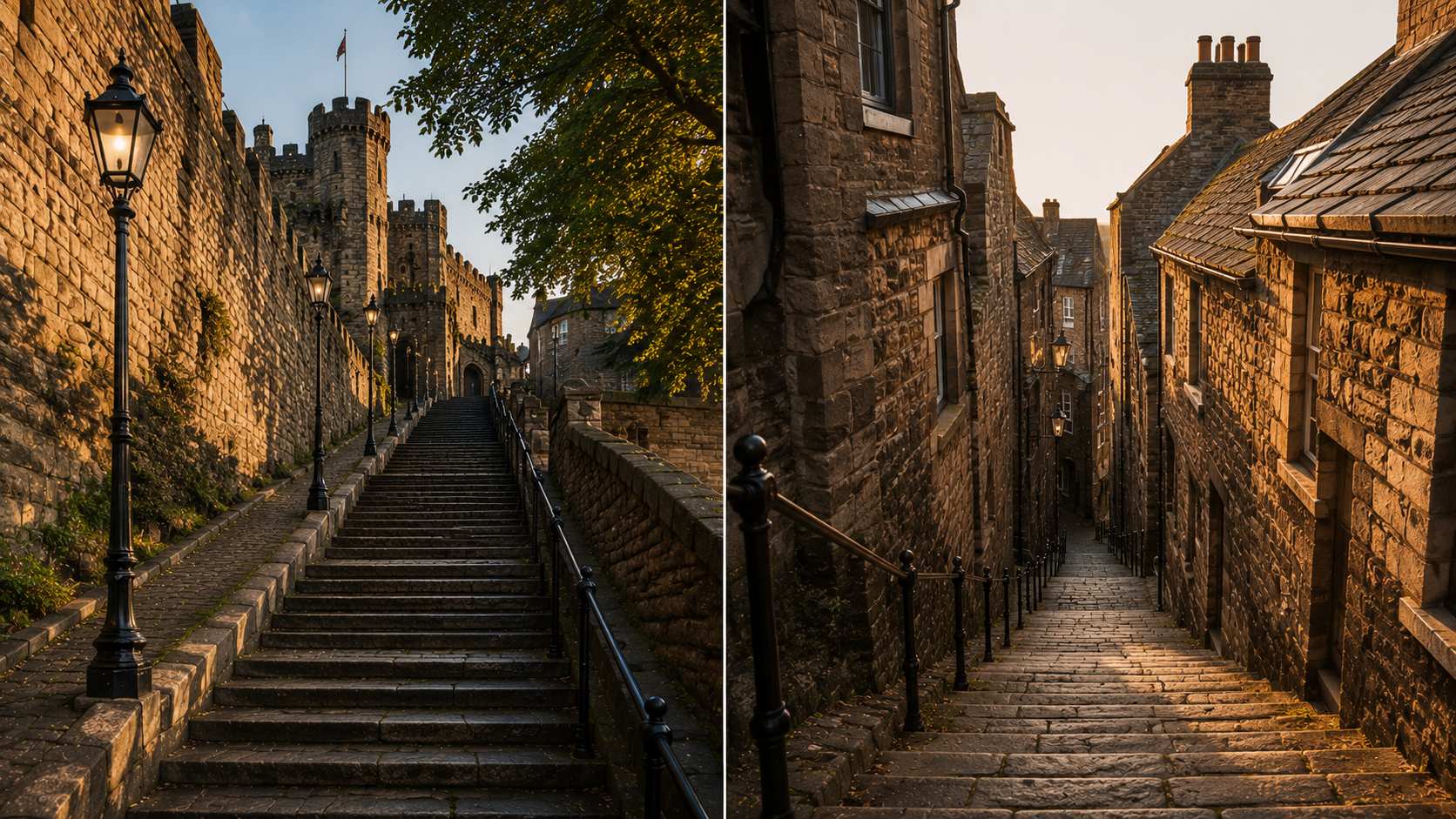
Newcastle Castle sits on genuinely elevated ground above the Tyne, a defensive advantage for medieval engineers but a practical daily inconvenience for anyone needing to travel between the castle precinct and the busy riverside trade below. Two steep stone stairways solved that problem for centuries, and both still survive today.
Connecting the Hill to the River
Newcastle's medieval and early modern topography placed its two most important zones, the fortified castle precinct on elevated ground and the working riverside trade along the Quayside and Sandhill, at genuinely different heights, connected by the town's winding main streets but also by a small number of considerably more direct, steep pedestrian stairways cut straight into the hillside. Castle Stairs and Dog Leap Stairs represent two of the most historically significant of these direct connecting routes, each linking Castle Garth to a different point on the riverside below.
Castle Stairs descends from the castle precinct down towards Sandhill, the historic merchant quarter that developed adjacent to the medieval bridge and Quayside, offering medieval pedestrians a direct, if physically demanding, route between the castle's elevated ground and the town's busy commercial riverside.
A Distinctive Name and a Sharp Turn
Dog Leap Stairs, connecting Castle Garth to Side, another historic street leading down towards the Quayside area, carries a name whose origin reflects the stairway's own physical character: a "dog leg" or sharp angular turn partway down its route, distinctive enough to earn the stairway its memorably specific name. That kind of vivid, descriptive local naming, drawn directly from a route's physical characteristics rather than any grander historical or commemorative association, is typical of the kind of organic, practical place-naming common throughout Newcastle's older medieval street pattern.
Both stairways would have seen constant, genuinely essential daily use throughout the medieval and early modern periods, carrying merchants, castle garrison members, and ordinary townspeople back and forth between the elevated castle precinct and the considerably busier commercial activity taking place along the riverside below.
Disrupted by the Railway
Like so much else within Castle Garth, both historic stairways felt the direct impact of Victorian railway construction during the 1840s. Dog Leap Stairs specifically had to be re-sited when the original 1849 railway viaduct was constructed, and again when that viaduct was subsequently widened during the 1890s, the historic stairway's exact route adjusted to accommodate the new railway infrastructure passing directly through the area it had traditionally occupied.
That disruption and relocation, rather than outright destruction, reflects the same broader pattern seen elsewhere in Castle Garth's Victorian-era history: significant compromise and adaptation forced by railway expansion, rather than the complete loss that had originally threatened the castle's own Keep and Black Gate before the Society of Antiquaries' successful 1847 campaign.
Walking History's Own Shortcuts
Both Castle Stairs and Dog Leap Stairs remain walkable routes today, offering modern pedestrians the same direct, steep connection between Castle Garth and the riverside below that medieval and early modern Novocastrians once relied upon for entirely practical, everyday purposes. Walking either stairway today means following a genuinely ancient pedestrian route, adjusted and relocated by railway construction but never entirely abandoned, connecting two of Newcastle's most historically significant zones exactly as it always has.
A Different Way to See the City
Descending either stairway offers a genuinely different perspective on Newcastle's layered topography than any main road can provide, a steep, close-up encounter with exactly the kind of elevation change that shaped so much of the city's medieval development, from the castle's own defensive advantage to the practical challenges faced by anyone needing to move goods and people between the hilltop and the river below.
These stairways rarely feature prominently in guidebook accounts of Newcastle's major landmarks, yet they represent something genuinely valuable in their own right: living, still-functioning fragments of the city's original medieval street pattern, offering an authentic, physically demanding alternative to the more gently graded modern roads that now provide easier, if less historically evocative, routes between the same two points.
