
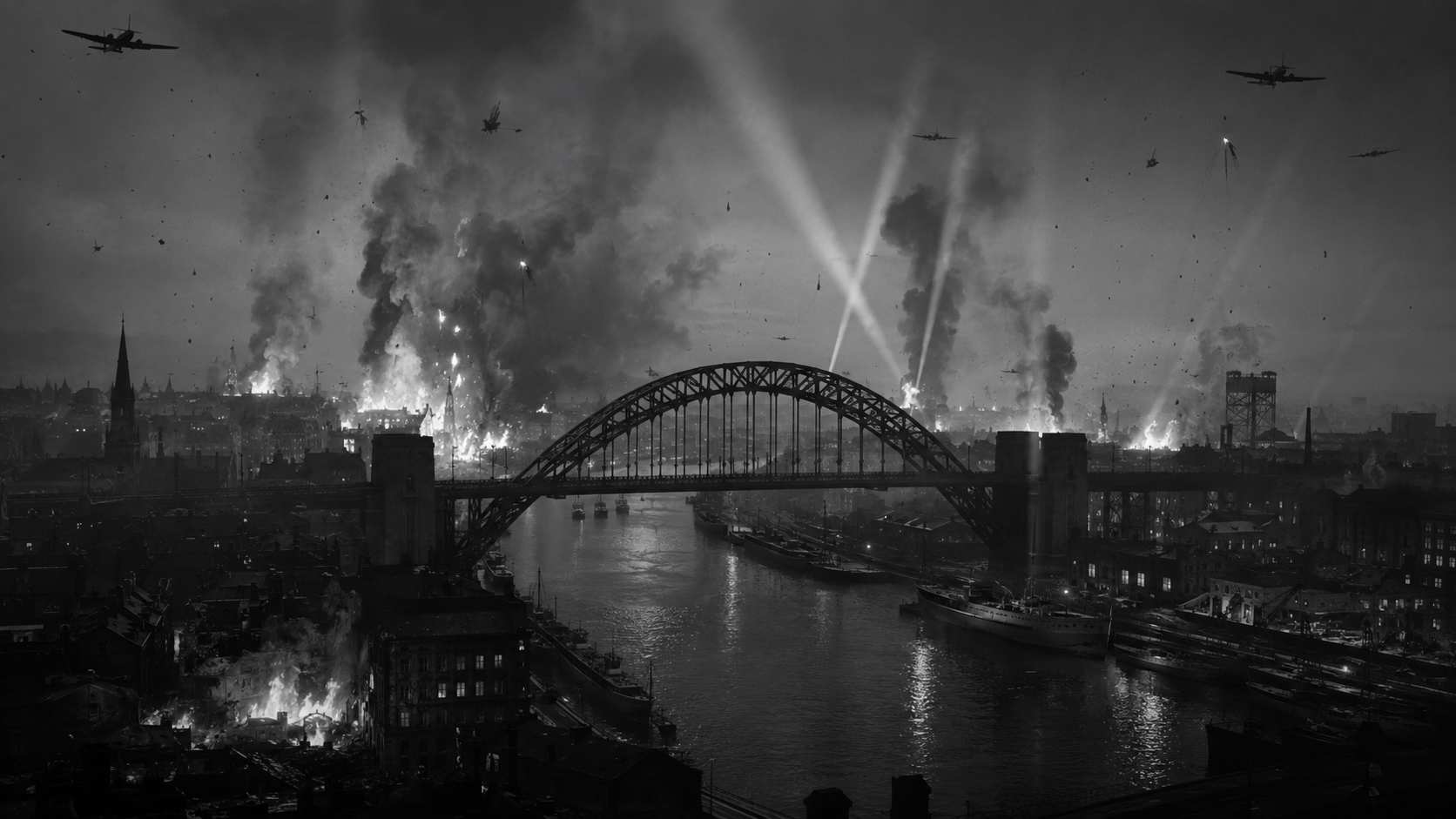
For a city more associated in the popular imagination with coal, ships and bridges than with the Second World War, Newcastle endured a genuinely sustained bombing campaign between 1940 and 1941, one that targeted precisely the industrial strength that had made the city so significant in the first place.
A Target Because of Its Industry
Newcastle's vulnerability came directly from its economic importance. Under the Führer's War Directive No. 9, Newcastle, North Tyneside, Wearside and Teesside in north-east England were all identified as significant strategic targets, chiefly because of their heavy industry and busy docks, which supplied coal to London and the south, and their major railway connections north into Scotland. Specific targets earmarked by the Luftwaffe included the Tyne's river bridges, the docks, Elswick's steelworks, Swan Hunter's shipyard, the Vickers Armstrong naval yard, and the Wallsend slipway, a target list that reads almost like an index of Newcastle's industrial history.
Preparations began even before the bombing did. Following Britain's declaration of war against Germany in September 1939, more than 30,000 people, the overwhelming majority of them children, were evacuated from Newcastle to safer areas including the Lake District and rural Northumberland, a precaution that would prove well justified.
The First Raids
The first major raid on Newcastle and neighbouring Gateshead came on 2 July 1940, deliberately targeting the High Level Bridge, that landmark piece of Victorian engineering completed nearly a century earlier. The raid killed 13 people and injured a further 123, an early demonstration that the "Phoney War" period, during which many Britons had hoped the conflict might remain relatively distant, was decisively over.
Further raids followed intermittently through the rest of 1940. On 15 August 1940, German bombers flying from occupied bases in Norway and Denmark targeted airfields in the region, with a number diverting to drop bombs on Newcastle and Sunderland after being intercepted by British fighters, evidence of how the geography of occupied Europe placed North East England within relatively easy striking distance of Luftwaffe bases.
1941: The Heaviest Losses
The most devastating individual raids came in 1941. On 25 April, German bombers attacked Newcastle with high explosive bombs, incendiaries and a parachute mine, killing 47 people and leaving dozens of homes uninhabitable. An even more destructive raid struck on 1 September 1941, causing a major fire at the New Bridge Street Goods Station that burned for a full week; that single raid left 50 people dead, 71 seriously injured, a further 140 slightly injured, and more than a thousand residents homeless.
The last substantial raid of what has become known as the Newcastle Blitz came on 29 December 1941, killing nine people in the Byker area of the city. Smaller "tip and run" raids by individual aircraft or small groups continued intermittently for a further two years afterwards, though nothing on the scale of the 1940 and 1941 attacks. In total, close to 400 people were killed across the roughly eighteen-month campaign.
A Comparatively Low Density, With Real Cost
By the standards of the very worst-hit British cities, Newcastle's overall bombing density was actually relatively low, a pattern analysts have attributed partly to the absence of a single, concentrated industrial core within the city itself, since Tyneside's factories, docks and shipyards were spread widely across South Shields, Tynemouth, Wallsend and the wider Port of Tyne rather than clustered in one easily targeted zone. Records suggest around 152 high explosive bombs and a single parachute mine fell within the old County Borough of Newcastle across the whole campaign, a modest figure set against cities further south, though that statistical fact offers little comfort measured against the human cost actually suffered on the ground. The destruction of homes across the city created a housing shortage that would go on to shape Tyneside's postwar rebuilding programme for years afterwards, with new estates eventually built to rehouse families displaced by the raids.
The Newcastle Blitz rarely receives the same national attention as the bombing of London, Coventry or Liverpool, but it left a genuine mark on the city, both in the immediate loss of life and in the decades of postwar housing reconstruction that followed. It stands as a stark reminder that the very industrial strength which built modern Newcastle, its bridges, shipyards and factories, also made it, for a period of eighteen months, a deliberate and repeated Luftwaffe target.