
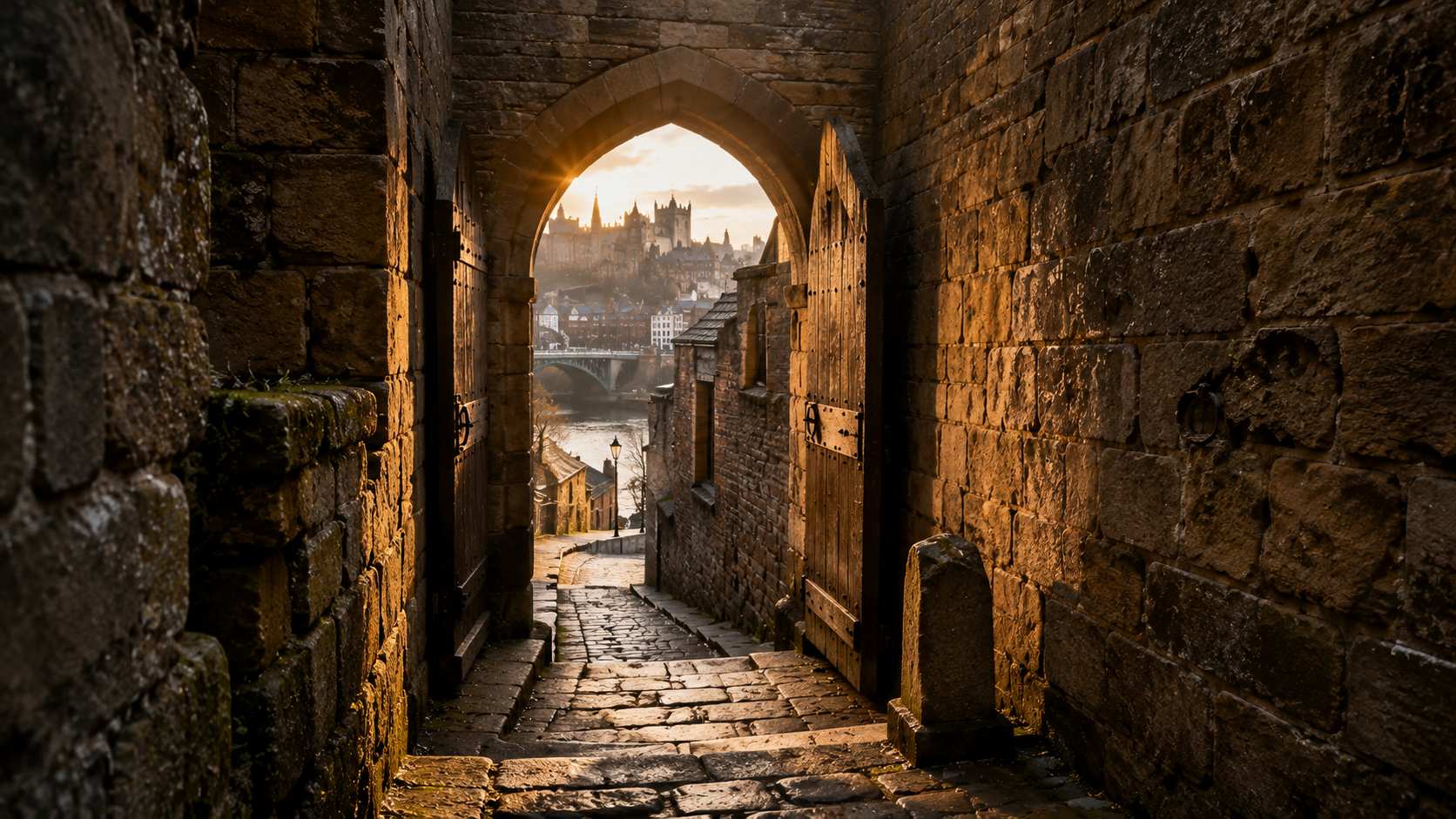
Six named gates get most of the attention in any account of Newcastle's medieval town wall, but a fortification nearly two miles long needed considerably more than six ways through it. Scattered along the wall's full circuit stood a further network of smaller postern gates, seventeen towers and assorted minor openings, the unglamorous infrastructure that actually made a medieval walled town function day to day.
More Than Six Ways In
Newcastle's town wall, built primarily during the thirteenth and fourteenth centuries, is usually remembered for its six principal gates: Close Gate, West Gate, New Gate, Pilgrim Gate, Pandon Gate and Sand Gate, the substantial, heavily fortified structures that controlled the main roads leading into and out of the medieval town. But alongside these major crossing points, the wall's full circuit incorporated numerous smaller postern gates, narrower openings intended for pedestrian use rather than the cart and livestock traffic the main gates were built to handle.
These postern gates served a genuinely practical function that the grander main gates could not efficiently provide. A pedestrian needing to slip in or out of the walled town, particularly for routine daily business rather than significant trade or travel, had no need to negotiate the same defensive checkpoint, and likely queue, that carts, livestock and larger trading parties faced at the six principal gates. Posterns offered a quicker, more direct alternative for exactly this kind of everyday local movement.
Seventeen Towers Along the Circuit
Beyond the gates and posterns, Newcastle's wall incorporated seventeen distinct towers spaced along its roughly two-mile length, structures that combined defensive surveillance with, in several documented cases, secondary civic functions entirely unrelated to the wall's original military purpose. Plummer Tower, built in the late thirteenth century and the only surviving two-storey tower along the entire circuit, later housed the Company of Masons, one of several examples of Newcastle's guilds repurposing what had originally been purely defensive military architecture for their own civic and commercial use.
Carliol Tower, believed to have been constructed around 1330 and named after Nicholas de Carliol, a mayor of Newcastle during this period, provides another example of this same pattern, later serving as a meeting hall for the town's Weavers before eventually disappearing from the modern streetscape entirely. That these substantial defensive towers could so readily transition into civic and guild use reflects how, as the direct military threat from Scotland gradually diminished across the following centuries, Newcastle's wall infrastructure increasingly found new, more peaceful purposes rather than falling immediately into complete disuse.
Defence That Doubled as Everyday Infrastructure
It would be a mistake to think of Newcastle's minor gates and towers purely in military terms, useful only during the periodic Scottish raids the main wall was primarily built to repel. For most of their working lives, these structures formed part of the ordinary daily fabric of a functioning medieval town, controlling routine movement, providing watch points that also served general civic surveillance purposes, and, in the case of the larger towers, offering usable interior space that guilds and civic bodies were often eager to acquire once purely defensive requirements eased.
This dual character, part military infrastructure, part everyday civic fabric, is easy to overlook when modern visitors encounter the wall's more dramatic surviving sections, particularly the well-preserved stretch known as the West Walls. But the smaller postern gates and towers were, in their own quieter way, just as essential to how medieval Newcastle actually functioned as its more celebrated main gates and the castle keep that anchored the whole defensive system.
Fragments Worth Seeking Out
Very little of this minor wall infrastructure survives intact today, a casualty of the same centuries of demolition and redevelopment that claimed most of Newcastle's main gates once the wall's original defensive purpose had become obsolete. What does survive, scattered fragments of towers, occasional lengths of curtain wall, requires genuine effort and local knowledge to locate amid the modern city that has grown up around and over them.
That scattered survival is, in its own way, an honest reflection of how minor medieval infrastructure typically fares over subsequent centuries, overshadowed by grander structures, gradually absorbed into new civic uses, and finally lost to redevelopment once its original purpose is forgotten. Newcastle's postern gates and towers may lack the visible drama of the Castle Keep or the cathedral's lantern tower, but they were every bit as much a part of how the medieval walled town actually worked.