
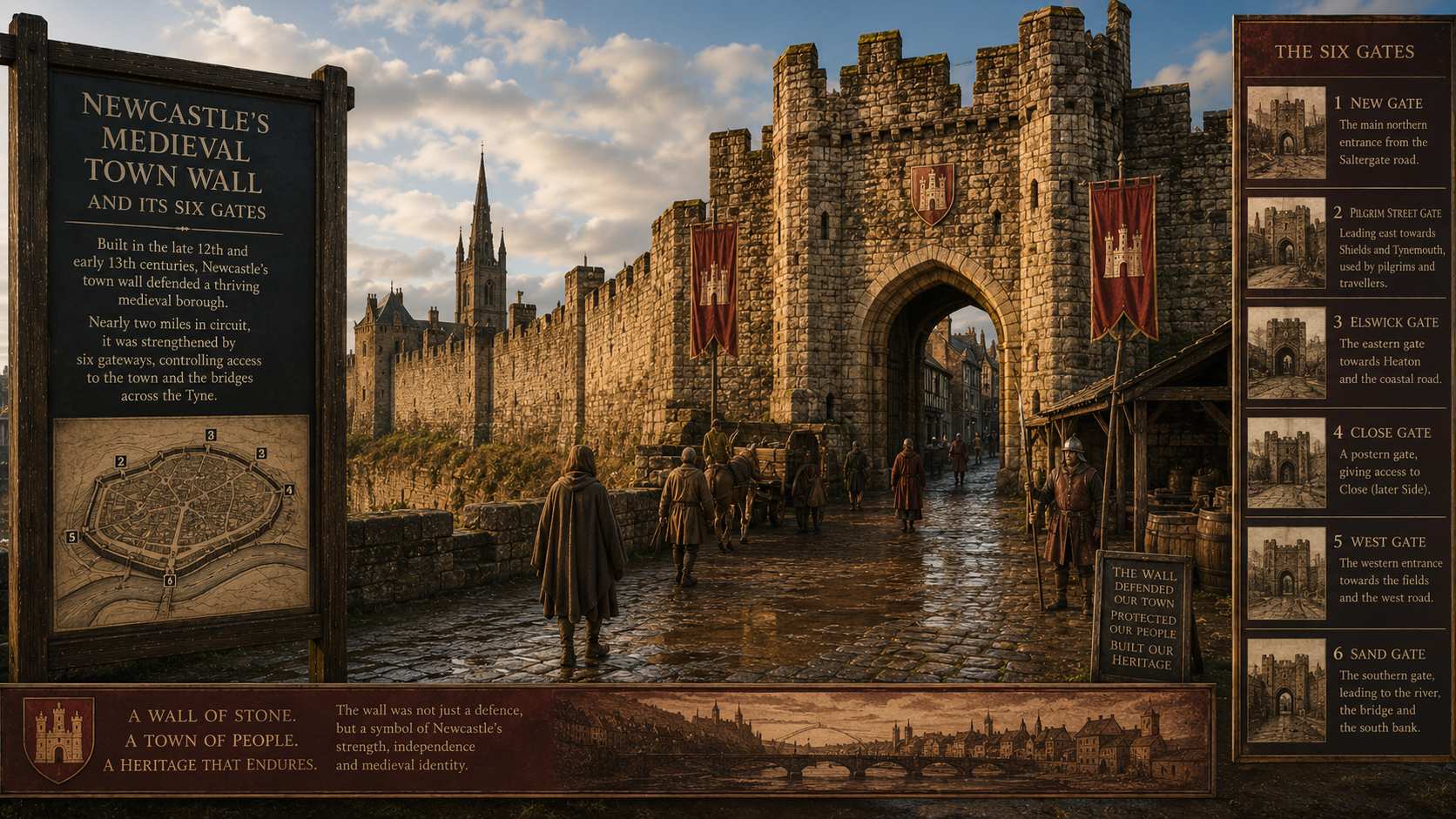
Newcastle Castle protected the crown's interests on the Tyne, but by the 13th century, the town growing up beside it needed defences of its own. What followed was one of the most ambitious building projects medieval Newcastle ever undertook: a wall nearly two miles long, built not by royal order but by the town's own merchants.
A Tax Called Murage
Newcastle's wealth by the 13th century came from trade, and trade attracted attention the town's leading burgesses would rather have done without, chiefly the threat of Scottish raids from across a border that lay only around sixty miles to the north. The castle alone, they judged, was not enough to protect a prosperous trading settlement whose wealth sat largely outside its walls.
The solution was a special levy known as murage, from the Latin murus, meaning wall. First imposed in 1265, the tax was collected from residents and traders to fund construction of a defensive circuit around the entire town. Murage continued to be levied for roughly the next hundred years, which gives a sense of just how long and how expensive the project actually was: this was not a wall built in one campaign, but one raised in phases across several generations, not substantially complete until the mid-14th century, with some riverside sections not finished until the 15th.
A Formidable Barrier
When finished, the wall was a serious piece of military engineering. It ran for approximately two miles, or three kilometres, enclosing more than 60 hectares of the medieval town. At its most substantial, the wall stood up to 7.6 metres, or 25 feet, high, and was at least two metres thick, backed in places by a defensive ditch known as a fosse. Along its length stood seventeen towers, along with numerous smaller turrets and postern gates for pedestrian access.
Six major gates controlled the principal routes in and out of town: Close Gate, West Gate, New Gate, Pilgrim Gate, Pandon Gate and Sand Gate. Each was a substantial fortified structure in its own right, not merely a gap in the stonework, reflecting how seriously the town took control over who could enter and leave, particularly during periods of heightened tension with Scotland.
Tested in War
The wall was not built for show. Newcastle successfully resisted Scottish attack on multiple occasions during the medieval period, a track record that justified the decades of murage payments. Its one significant failure came much later, and from an unexpected direction: during the English Civil War, in the siege of 1644, an army of around 30,000 Scottish troops besieged the town and eventually breached the wall using mines and artillery, forcing Newcastle's Royalist defenders to surrender after a prolonged and bitter fight.
That siege left its own mark on the city's identity. Newcastle later adopted the Latin motto "Fortiter Defendit Triumphans" — roughly, "triumphing by brave defence" — for its coat of arms, a direct nod to the resilience shown during the 1644 siege even though the wall itself had ultimately been breached.
Where the Wall Survives Today
As the centuries-old threat from Scotland faded and Newcastle's population grew, the wall gradually lost its purpose. By the mid-18th century it was widely seen as an obstacle to a growing town rather than a necessary defence, and over the following hundred years large sections were demolished to make way for new streets and buildings, with the stone frequently recycled into later construction.
The most substantial surviving stretch runs along the western side of the city centre, known today as the West Walls, where visitors can still walk alongside genuine medieval stonework in the shadow of modern Newcastle. Individual towers survive elsewhere in more altered forms: Plummer Tower, built in the late 13th century, is the only surviving two-storey tower and was later home to the Company of Masons, while other fragments turn up in unexpected corners of the city centre for anyone willing to look past the shopfronts and traffic. Together, these remnants are a physical reminder that medieval Newcastle was, quite literally, a walled city built to survive on a contested northern frontier.