
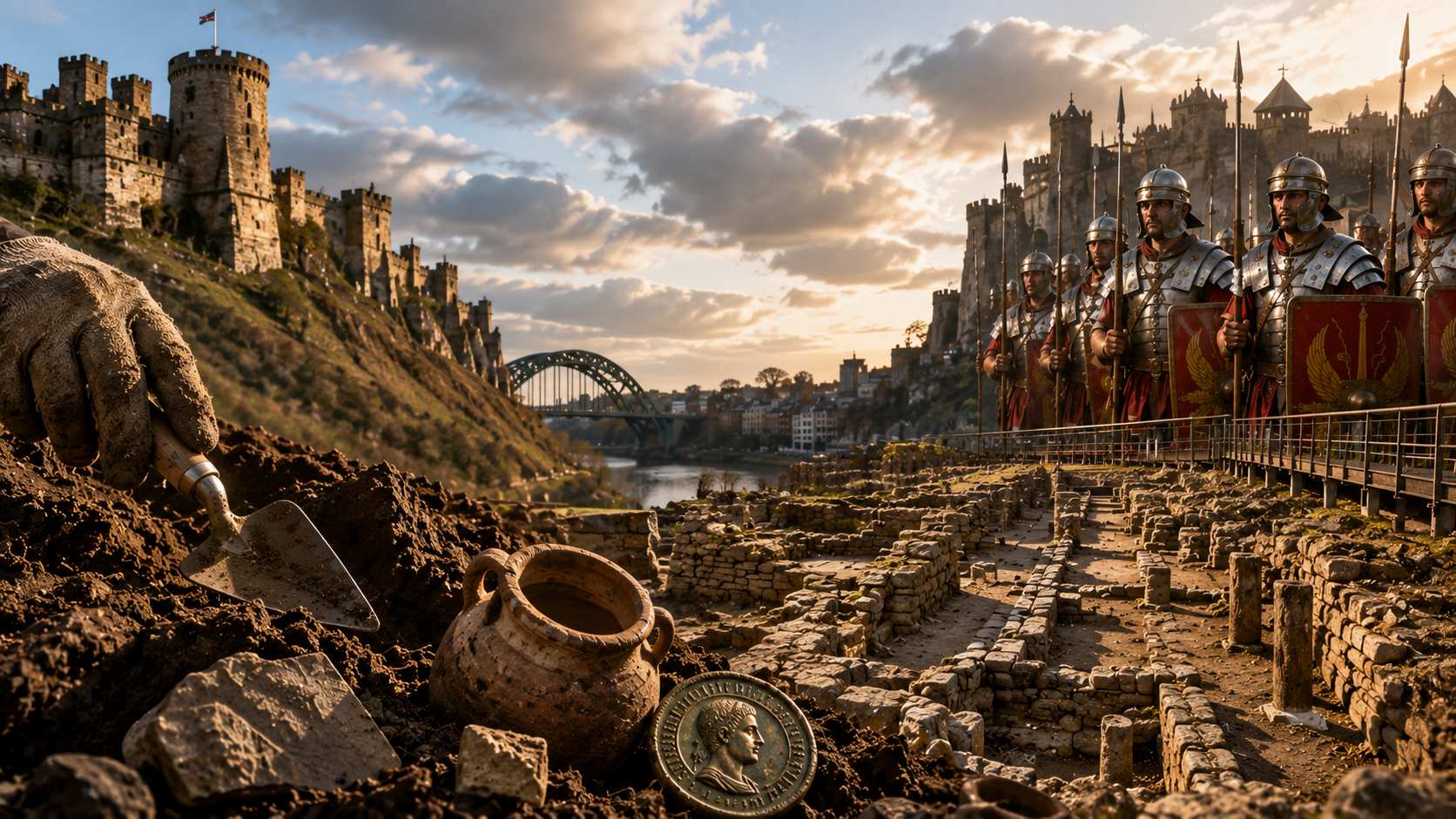
Almost everything now known about Roman Newcastle has been pieced together the hard way, fragment by fragment, over more than a century and a half of excavation, much of it hampered by the simple fact that people never stopped building on top of the evidence.
An Awkward Site for Archaeology
Newcastle Castle's own construction history is precisely what makes the Roman remains beneath it so difficult to study. The site has been continuously occupied and rebuilt since the Norman castle first rose here in 1080, meaning any Roman archaeology surviving underground sits beneath nearly a thousand years of subsequent medieval, Georgian and Victorian construction, disturbance and rebuilding, layers of evidence stacked on top of each other in ways that make clean archaeological interpretation genuinely difficult.
Early interest in the site's Roman past dates back to the nineteenth century, when limited investigations during various rounds of castle renovation occasionally turned up Roman material by chance rather than through any planned archaeological programme. These early encounters were valuable but frustratingly fragmentary, hampered both by the site's continuous occupation and by archaeological methods far less rigorous than those used today.
1929: The First Systematic Dig
The first genuinely systematic archaeological investigation of the Roman fort came in 1929, when excavations led by the archaeologist F.G. Simpson began the slow process of properly mapping what actually survived beneath the medieval castle above. That work marked a genuine turning point, moving Roman Newcastle from a subject of occasional antiquarian curiosity towards one of serious, methodical archaeological study, even though excavation opportunities remained inherently limited by the site's ongoing use as a functioning historical landmark and, eventually, tourist attraction in its own right.
Subsequent decades brought further, intermittent investigation as opportunities arose, typically tied to building works, repairs or planned redevelopment elsewhere on or near the castle site, each new intervention adding another small piece to the overall picture without ever offering archaeologists the luxury of a single, comprehensive, uninterrupted excavation of the kind possible at less heavily built-over Roman sites further out in open countryside.
Piecing Together a Fragmentary Picture
What has emerged from this patchwork of investigation, spanning nearly a century of formal archaeological work and considerably longer if the earlier antiquarian discoveries are counted too, is a genuinely detailed picture of Pons Aelius built almost entirely from fragments: sections of ditch, pottery scatters, evidence of the fort's internal street layout, traces of the market space identified within its walls, and scattered inscriptions recording individual soldiers, units and dedications to gods including the uniquely local Antenociticus, found separately at Benwell.
A small section of the Roman fort's actual masonry remains visible today near a railway arch by Castle Garth, one of the few places in the city centre where visitors can see genuine Roman stonework rather than simply reading about it on an interpretation board, a modest but tangible physical connection to nearly two thousand years of continuous archaeological interest in this single, heavily built-over site.
An Ongoing Story, Not a Finished One
Roman Newcastle remains, in a genuine sense, an unfinished archaeological project. Unlike more isolated wall forts further west, where entire ground plans have been comprehensively excavated and can be walked in full by any visitor, Pons Aelius will likely never be fully revealed, simply because doing so would require disturbing a still-functioning historic castle, a busy modern city centre, and everything built on top of the Roman remains across the intervening centuries.
Modern archaeological techniques offer some hope of narrowing that gap without further disturbing the site itself. Ground-penetrating radar, laser scanning and careful reassessment of finds from earlier, less rigorous excavations continue to add small refinements to the overall picture, even when no new digging takes place at all. Each generation of archaeologists effectively inherits not just the physical site but also the accumulated record of everyone who investigated it before them, a second, paper archive almost as valuable as the buried stones and pottery themselves.
That incompleteness is, in its own way, an honest reflection of how most urban Roman archaeology actually works. Newcastle's Roman history has never been handed to historians in one complete, tidy package. It has been recovered slowly, opportunistically, and often accidentally, across nearly two centuries of investigation, with each small find adding to a picture that remains, even now, genuinely incomplete, and very possibly always will be.