
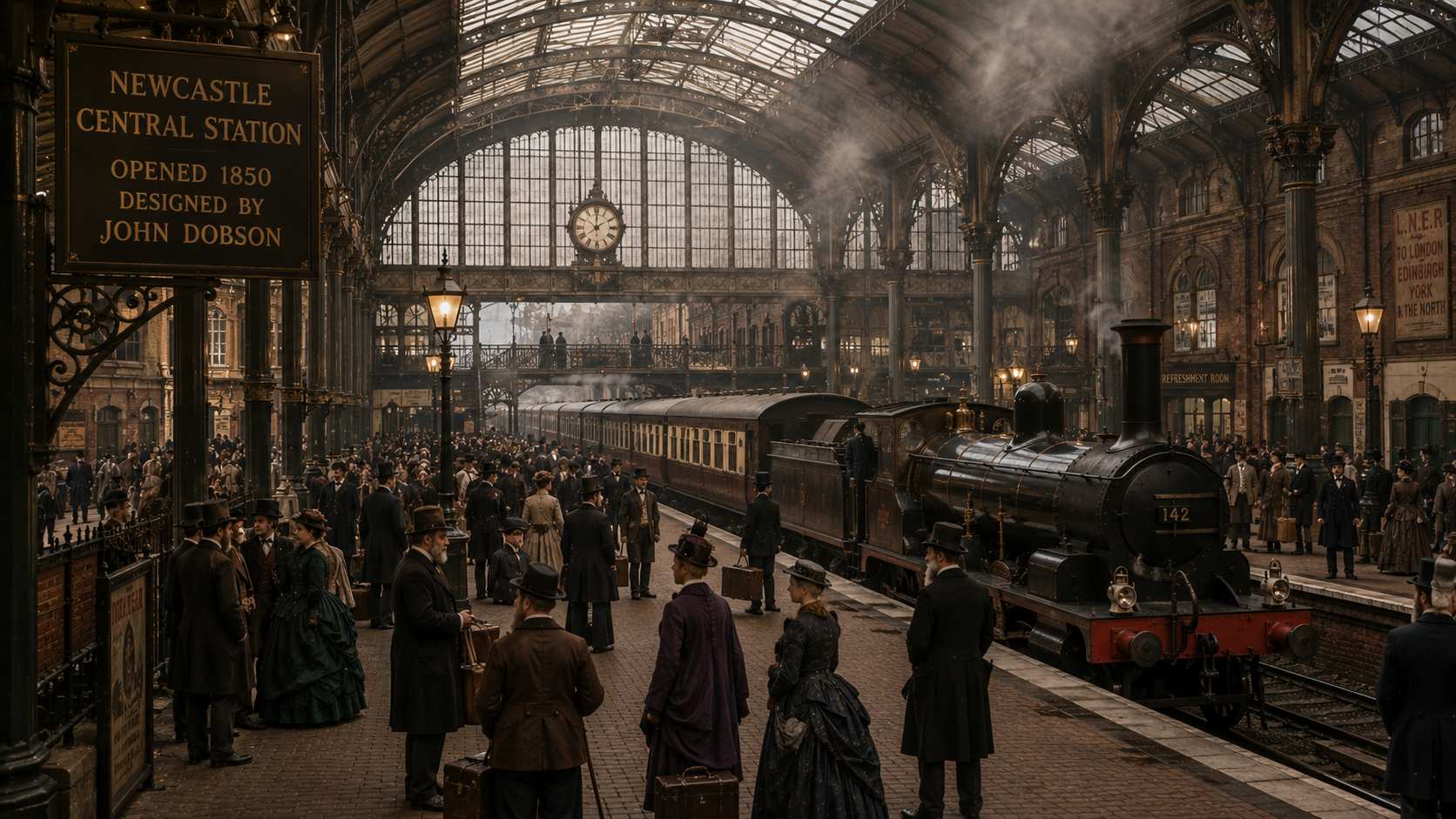
By the middle of the nineteenth century, Newcastle was already famous for one architect's vision of what a modern city centre could look like. That same architect, John Dobson, went on to design something arguably even more ambitious just a short walk away: a railway station built to match the grandest civic buildings of the age.
A City Ready for the Railway Age
Newcastle's rapid growth through the early nineteenth century, driven by trade, coal and the ambitious redevelopment of its city centre under Richard Grainger and John Dobson, coincided with Britain's equally rapid expansion of railway infrastructure. By the 1840s, competing railway companies were racing to connect the industrial north with London and Edinburgh, and a city of Newcastle's growing importance needed a station capable of handling the resulting surge in passenger and freight traffic.
The task of designing that station fell to Dobson, already established as the region's most accomplished architect through his extensive work on Grainger's neoclassical redevelopment of the city centre during the 1830s. Central Station represented a different kind of architectural challenge from the elegant curved terraces of Grey Street: a genuinely modern piece of transport infrastructure that nonetheless needed to convey the same sense of civic grandeur and permanence.
A Curved Train Shed
Central Station opened in 1850, its most striking feature an innovative curved train shed, a departure from the straight-line sheds more commonly used elsewhere, necessitated by the curving path the railway lines needed to follow through this section of the city. Dobson turned that engineering constraint into a genuine architectural triumph, creating a series of graceful curved iron and glass roof spans that remain, even today, one of the most visually impressive railway train sheds anywhere in Britain.
The station's grand neoclassical portico, facing onto Neville Street, provided exactly the kind of imposing civic frontage Victorian Newcastle expected from its major public buildings, an entrance designed to impress arriving visitors with the scale and confidence of the city they were entering, in keeping with the same architectural ambitions that had already reshaped Grey Street and the surrounding Grainger Town district over the previous decade.
A Junction for the Nation
Central Station's completion coincided closely with the opening of Robert Stephenson's High Level Bridge in 1849, the combined road and rail crossing that finally gave Newcastle a direct rail link across the Tyne to Gateshead and the lines running further south. Together, station and bridge transformed Newcastle into a genuinely significant junction on the emerging East Coast route between London and Edinburgh, cementing the city's role as a crucial staging point for national rail traffic rather than merely a regional terminus.
That strategic position brought Newcastle firmly into the heart of Victorian Britain's railway age, an infrastructure revolution that transformed how people, goods and information moved around the country at a speed and scale entirely unprecedented in human history. For a city whose wealth had traditionally depended on river and sea transport, the railway represented a genuinely new kind of connectivity, one that Central Station's grand architecture was clearly designed to celebrate rather than merely accommodate.
A Building That Still Impresses
Central Station's Victorian grandeur remains largely intact today, its curved train shed still sheltering passengers exactly as Dobson intended, even as the trains passing beneath it have changed beyond anything their nineteenth-century designers could have imagined. The building stands as a testament to a particular Victorian confidence, the belief that even purely functional transport infrastructure deserved genuinely serious architectural ambition, rather than merely utilitarian construction.
Dobson himself, who had already shaped so much of central Newcastle's Georgian and neoclassical character through his work with Richard Grainger, added one more enduring landmark to that legacy with Central Station, a building that continues to serve exactly the purpose he designed it for, more than a century and a half after its doors first opened to Victorian passengers eager to travel faster and further than any previous generation of Novocastrians had ever been able to.