
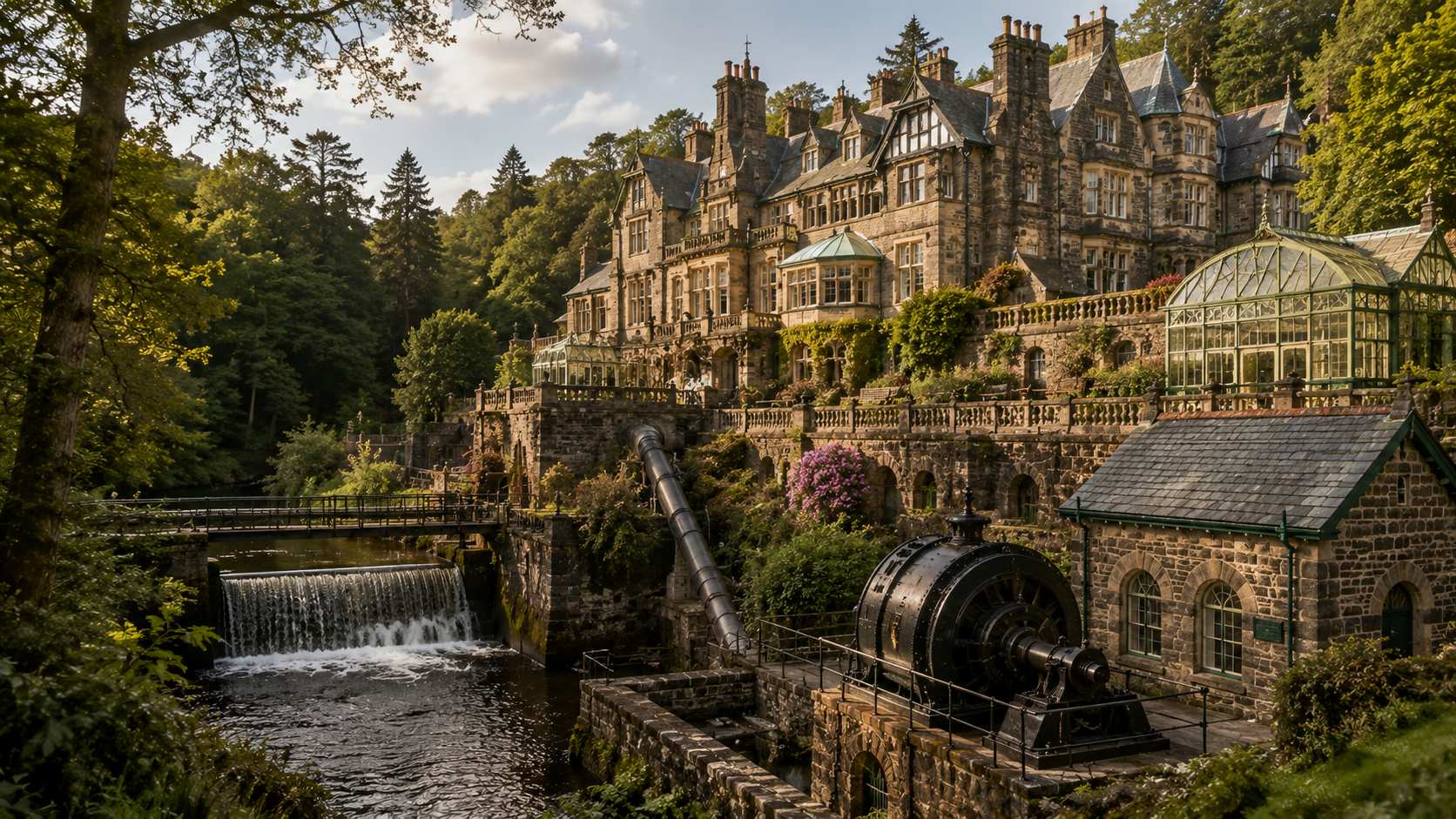
Newcastle's most celebrated Victorian engineer did not confine his ambitions to bridges, guns and cranes. At his own Northumberland estate, William Armstrong built something genuinely unprecedented: the first house anywhere in the world lit by hydroelectric power, a private residence that doubled as a working showcase for his own engineering philosophy.
An Engineer's Personal Laboratory
Cragside began, in the 1860s, as a comparatively modest hunting lodge on a dramatic, steeply wooded Northumberland hillside, before Armstrong, flush with the wealth generated by his Elswick engineering empire on the Tyne, transformed it across subsequent decades into one of the most technologically advanced private houses anywhere in the world. For Armstrong, an engineer as much by personal passion as by profession, Cragside became something closer to a continuous, evolving demonstration project than a conventional country retreat.
The estate's dramatic hillside setting, initially more a landscaping challenge than an asset, proved perfectly suited to exactly the kind of hydraulic engineering that had made Armstrong's fortune in the first place. He engineered an extensive system of artificial lakes and watercourses across the grounds, capturing and directing the natural flow of water down the hillside to power an ambitious range of estate machinery, laying the groundwork for what would become his most famous domestic achievement.
The First House Lit by Water Power
In 1878, Cragside became the first house anywhere in the world to be lit using hydroelectric power, generated on-site using the same fundamental hydraulic engineering principles Armstrong had spent his entire career refining, now applied for the first time to electricity generation rather than his more familiar cranes and hydraulic machinery. Water channelled from the estate's artificial lakes drove generating equipment that supplied electric lighting throughout the house, a genuinely unprecedented domestic application of technology still very much in its infancy elsewhere in the world.
That achievement connected directly to Newcastle's own parallel role in electric lighting history. Armstrong had personally presided over Joseph Swan's historic 1879 demonstration of the incandescent light bulb at Newcastle's Literary and Philosophical Society, and Cragside's own hydroelectric lighting system incorporated Swan's bulbs directly, making the estate one of the earliest and most prominent domestic applications anywhere of exactly the incandescent lighting technology Swan had pioneered in Newcastle just months earlier.
Entertaining the World's Elite
Cragside's genuinely spectacular combination of dramatic landscape, technological innovation and considerable architectural grandeur made it a natural destination for visiting dignitaries eager to witness Armstrong's engineering achievements firsthand. Recorded guests at Cragside included the Shah of Persia, the King of Siam, the Prime Minister of China, and the future King Edward VII alongside Queen Alexandra, an extraordinary roster of international visitors for what had begun, only decades earlier, as a modest Northumberland hunting lodge.
Armstrong's personal interests extended well beyond electrical and hydraulic engineering into horticulture and landscape design on an equally ambitious scale. He is estimated to have planted some seven million trees and shrubs across the Cragside estate during his lifetime, transforming the surrounding hillside into an extensively landscaped, carefully engineered environment that combined genuine natural beauty with the same meticulous technical planning Armstrong applied to every other aspect of his professional and personal life.
A Monument to One Engineer's Vision
Cragside stands today as perhaps the most complete surviving expression of William Armstrong's engineering philosophy, applied not to industrial production or military armaments but to the comparatively intimate scale of a single private household, transformed through decades of sustained hydraulic and electrical innovation into a genuine world-first technological landmark. Where Elswick demonstrated Armstrong's engineering at industrial scale and the Swing Bridge showcased it applied to civic infrastructure, Cragside revealed the same underlying obsession with harnessing the power of moving water turned inward, towards his own family home.
Though the estate sits in rural Northumberland rather than within Newcastle itself, Cragside's story is inseparable from the city that made Armstrong's fortune and provided the engineering expertise, the Elswick workforce, and even the Swan light bulbs, that made this remarkable private achievement possible in the first place.