
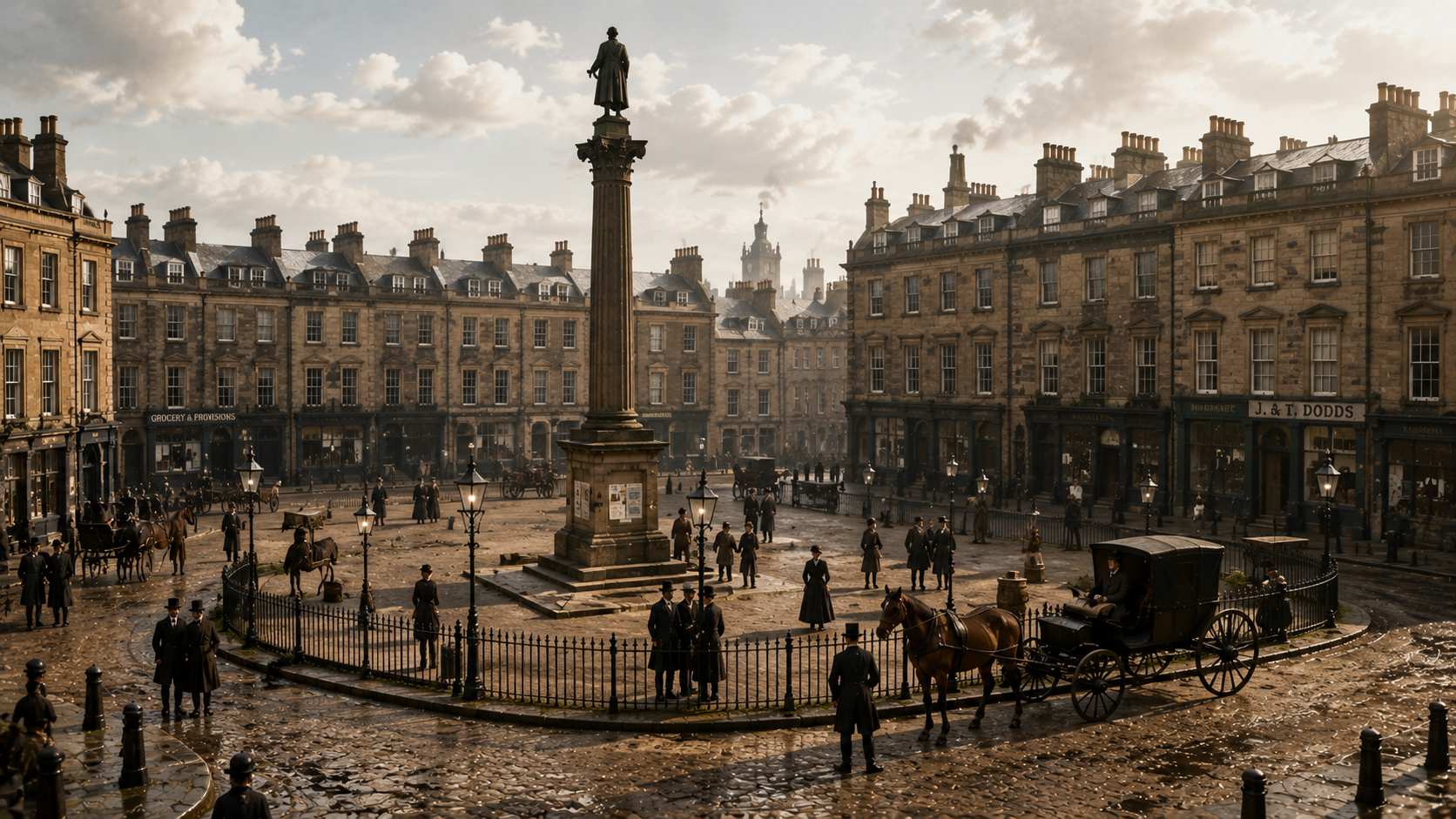
Not every chapter in Newcastle's architectural history has a happy ending. Old Eldon Square was once considered one of the finest Georgian squares anywhere in England, a genuine rival to the grandest residential architecture London or Bath could offer. Most of it no longer exists.
A Square Built for Newcastle's Elite
Eldon Square was constructed in the 1820s, part of the broader wave of ambitious neoclassical development that would soon culminate in Richard Grainger's transformation of the wider city centre during the following decade. Named after Lord Eldon, a prominent Newcastle-born Lord Chancellor, the square was designed as an elegant residential address for the city's wealthiest merchant and professional families, its terraced Georgian facades arranged around a formal central garden in the manner of London's most fashionable residential squares.
The square's architectural quality was, by contemporary accounts, exceptional, representing some of the finest surviving Georgian domestic architecture anywhere in the north of England. For much of the nineteenth century, Eldon Square remained exactly what its original developers had intended: a genuinely prestigious residential address, home to Newcastle's professional and mercantile elite, sitting at the heart of the city's rapidly expanding commercial centre.
From Homes to Offices
As Newcastle's city centre grew increasingly commercial through the Victorian era and into the twentieth century, Eldon Square's original residential character gradually gave way to office and institutional use, a common pattern affecting formerly grand residential squares in expanding city centres across Britain during this period. The square's elegant Georgian buildings proved adaptable enough to accommodate this shift without requiring wholesale demolition or reconstruction, their fundamentally sound Georgian construction and generous proportions lending themselves reasonably well to conversion for office and commercial purposes.
That adaptability, ironically, may have contributed to what eventually happened to most of the square. Buildings serving primarily commercial rather than treasured residential purposes proved considerably more vulnerable to later redevelopment pressure than homes still occupied by families with a direct personal stake in their preservation.
Demolished for a Shopping Centre
The decisive blow came during the 1960s and 1970s, a period when British planning policy, Newcastle's very much included, favoured large-scale comprehensive redevelopment over the preservation of existing historic fabric, however architecturally significant that fabric might be. Much of Old Eldon Square was demolished during this period to make way for a major new shopping centre, part of a broader wave of Newcastle city centre redevelopment that also claimed roughly a quarter of Richard Grainger's own original neoclassical scheme from the 1830s.
The scale of the loss only became fully apparent in retrospect, as changing attitudes towards heritage conservation through the later twentieth century increasingly recognised just how architecturally significant the buildings cleared during this period had actually been. What had seemed, to 1960s planners, like sensible modernisation of an ageing, increasingly commercial city centre came, within a generation, to look instead like a genuinely serious act of heritage destruction.
What Remains
A single surviving terrace of the original Georgian square still stands today, on the northern side, preserved even as the shopping centre that now bears the Eldon Square name occupies much of the site where the rest of the historic square once stood. That fragment offers modern visitors a small but genuine glimpse of what the wider square once looked like, elegant Georgian facades of exactly the quality contemporary observers had praised so highly during the square's original nineteenth-century heyday.
The surviving terrace is now a listed building in its own right, formal legal protection that came only after the wider square's demolition had already made the value of what remained starkly, unavoidably clear. That sequence, significant heritage loss first, stronger protective measures only afterwards, is a pattern repeated at heritage sites across Britain during the same turbulent decades of comprehensive postwar redevelopment, Newcastle's own experience a particularly well-documented local example of a much wider national story.
Eldon Square's story stands today as a cautionary counterpoint to Newcastle's better-known heritage preservation successes, Grainger Town's substantial survival, Blackfriars' guild-hall afterlife, the town wall's protected remaining sections. Not every significant piece of Newcastle's Georgian and Victorian architectural inheritance survived the twentieth century intact, and Eldon Square remains the clearest, most poignant reminder of exactly what the city lost when comprehensive redevelopment briefly took precedence over conservation.