
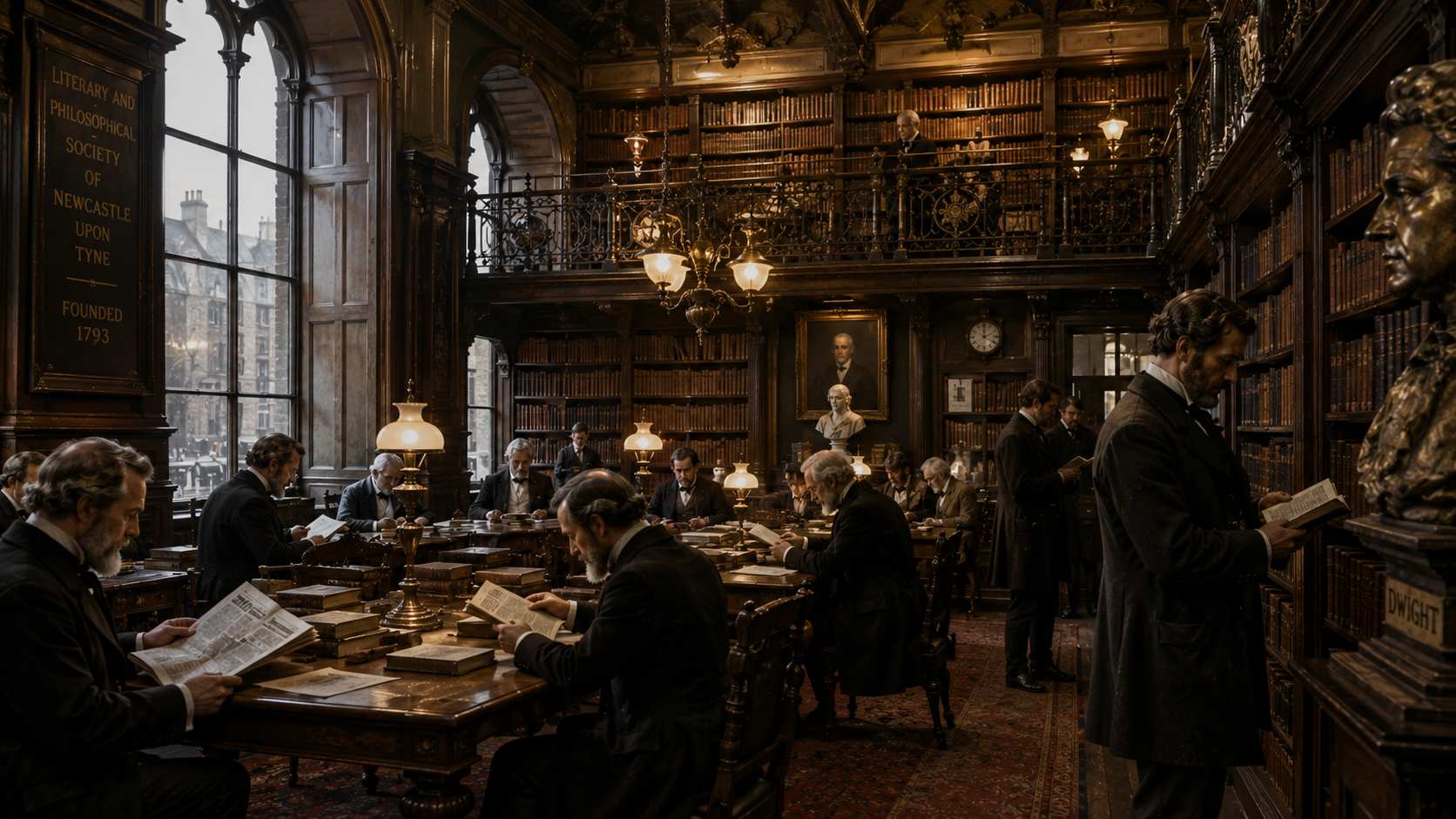
Beyond its role as the birthplace of electric public lighting, the Literary and Philosophical Society, universally known in Newcastle as the Lit and Phil, was something considerably more significant to the city's Victorian identity: the closest thing Newcastle had to an intellectual town square, where the region's scientists, engineers, industrialists and reformers gathered, argued and occasionally changed the course of technological history.
An Institution Built for Debate
Societies of this kind, combining a substantial subscription library with regular public lectures and debates, flourished across industrial Britain during the eighteenth and nineteenth centuries, part of a broader movement towards organised, accessible intellectual life outside the traditional confines of universities and the church. Newcastle's own Literary and Philosophical Society became one of the most significant examples of this model anywhere in provincial Britain, reflecting the intellectual ambitions of a city whose industrial wealth increasingly matched its appetite for scientific and cultural self-improvement.
The Society's library grew into one of the most substantial collections held by any subscription library outside London, a resource that gave Newcastle's merchants, engineers and professionals direct access to scientific and technical literature that would otherwise have been available only to those with university connections elsewhere in the country. For a city built substantially on practical engineering achievement, from Armstrong's hydraulics to Stephenson's railways, that access to serious scientific literature was no mere luxury.
Where Ideas Were Tested in Public
The Lit and Phil's lecture theatre became, particularly through the second half of the nineteenth century, a genuine proving ground for new scientific and technical ideas, a place where local inventors and thinkers could present their work directly to an informed, engaged audience of fellow Novocastrians. It was precisely this culture of open scientific demonstration that gave Joseph Swan the natural venue for his own historic public trials of the incandescent light bulb, first before the Chemical Society in December 1878, then before a considerably larger Lit and Phil audience the following February.
That connection between Swan and the Lit and Phil culminated on 20 October 1880, when the Society's own premises became the first public room anywhere in the world lit entirely by electric light, a milestone Swan achieved specifically within this institution rather than in some more anonymous laboratory setting. The choice was fitting: nowhere else in Newcastle offered quite the same combination of technical audience, public visibility and institutional prestige that made the demonstration genuinely count as a public, verifiable achievement rather than a private laboratory curiosity.
A Society Shaped by Industry
Victorian Newcastle's leading industrial figures took an active, personal interest in the Lit and Phil's affairs, reflecting how closely the city's intellectual and commercial elites overlapped during this period. Sir William Armstrong himself presided over Swan's most famous 1879 demonstration, a direct personal endorsement from the region's most celebrated engineer that lent Swan's still-developing technology considerable additional credibility and public attention.
That pattern, industrialists and inventors moving in the same intellectual circles, debating and demonstrating ideas within the same institutional walls, was characteristic of how Victorian Newcastle's remarkable run of engineering achievement actually happened. The city's industrial success was never purely a matter of individual genius working in isolation; it depended substantially on exactly the kind of shared intellectual infrastructure the Lit and Phil provided, a space where practical engineers and theoretical scientists could exchange ideas across a shared table.
Still Newcastle's Living Room for Ideas
The Lit and Phil's Westgate Road building survives today, still functioning as an independent library and cultural institution, its blue plaque marking Swan's historic demonstration alongside a continuing programme of talks, events and public engagement that echoes, in its own modern form, the same basic Victorian mission the Society was founded to serve. Few buildings anywhere in Newcastle can claim quite so direct a connection to a genuine world-first scientific milestone, achieved not in some remote laboratory but in a public lecture theatre built specifically for exactly this kind of shared intellectual life.