
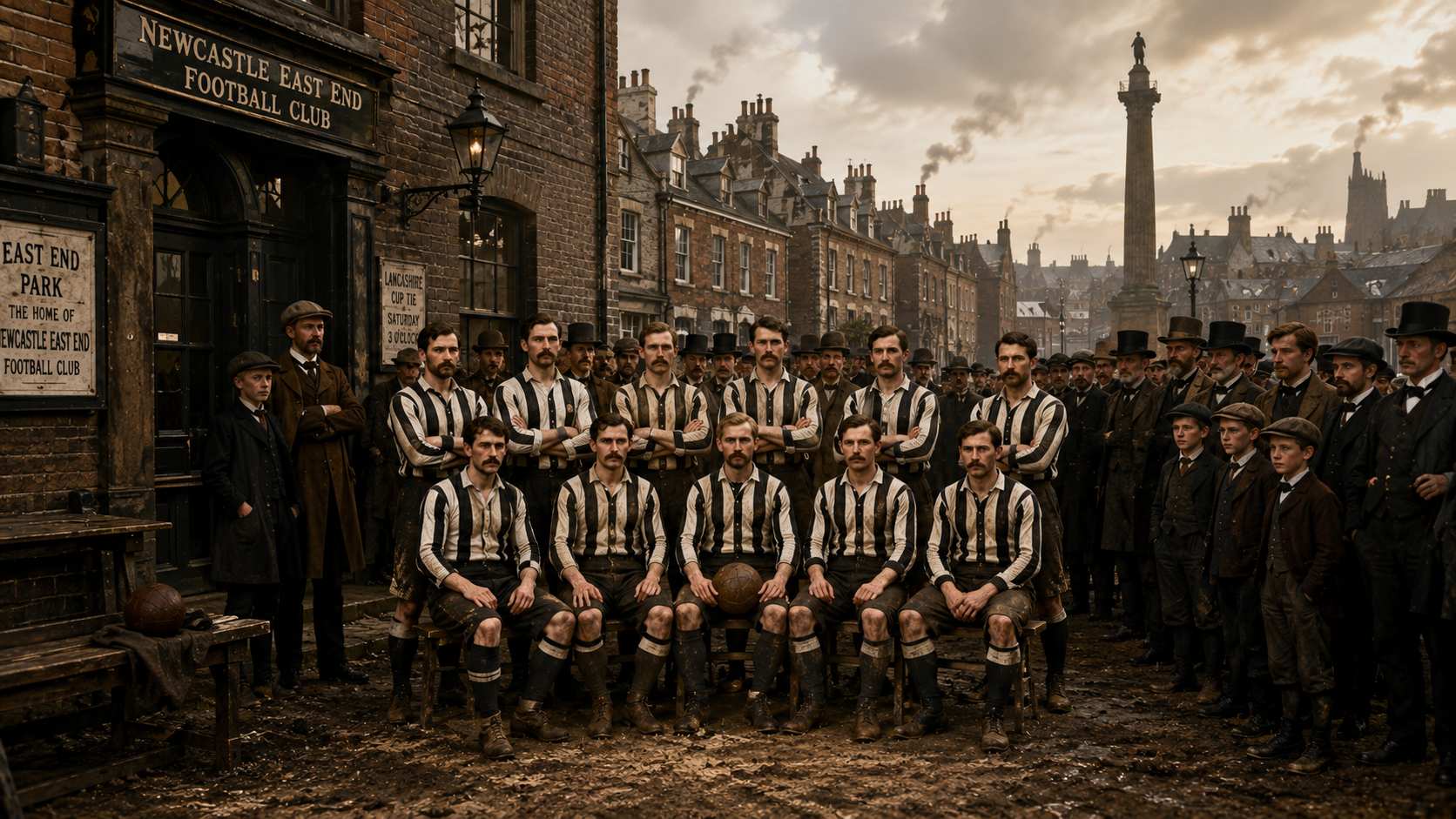
Newcastle United, one of English football's most fervently supported clubs, did not begin life as a single, unified team at all. Its Victorian origins involve two separate rival clubs, a merger, and a considerable amount of local football politics before the famous black and white shirts finally settled at St James' Park for good.
Two Clubs, One City
Organised football in Newcastle during the 1880s developed, as in many industrial cities during this period, through a scattering of local clubs formed by workplaces, churches and neighbourhood groups, gradually consolidating into more formally organised teams as the sport's popularity grew across working-class Victorian Britain. Two clubs based in different parts of the city, Newcastle East End and Newcastle West End, emerged as the city's leading footballing sides during this formative period, each developing its own following and competing, at various points, both against each other and for the city's limited pool of talented local players.
West End had established itself at St James' Park, the ground that would eventually become permanently associated with Newcastle football, while East End played at a separate ground elsewhere in the city. Both clubs experienced the kind of financial instability common to many early professional football clubs during this period, when the sport's commercial structures were still very much in their formative stages.
A Merger Born From Necessity
West End's financial difficulties eventually proved terminal for the club as an independent entity. Rather than seeing organised football in this part of the city collapse entirely, East End effectively absorbed West End's operations in 1892, taking over the St James' Park ground in the process, a practical merger driven substantially by financial necessity rather than any grand strategic vision for the city's footballing future.
Shortly after this consolidation, the newly combined club rebranded itself as Newcastle United, adopting a name intended to represent the whole city rather than either of the two separate, previously rival organisations whose merger had actually created it. That renaming marked the effective founding moment of the club that exists today, even though its roots, and much of its early playing squad and administrative structure, traced back through both of the original East End and West End organisations.
Settling Into Black and White
Newcastle United's now-famous black and white striped shirts were not part of the club's identity from its very first Victorian matches, with early kit choices for both predecessor clubs varying rather more than modern supporters, accustomed to the club's now-iconic colours, might expect. The black and white stripes that eventually became permanently associated with the club settled into place gradually during these formative years, and persistent local legend, impossible to verify with any real documentary certainty, connects the choice back to the black and white habits once worn by the Dominican friars of Blackfriars, Newcastle's surviving medieval friary a short distance from the city centre.
Whatever the true origin of the colours, they proved a lasting choice. Newcastle United's black and white stripes have remained essentially unchanged in their basic concept for well over a century since this formative Victorian period, one of English football's most immediately recognisable kit designs, closely bound up with the city's own sense of footballing identity ever since.
A Club Shaped by Victorian Industry
Newcastle United's emergence during this period cannot be separated from the wider industrial and social changes reshaping Victorian Newcastle more broadly. Organised football's rapid growth in popularity during the 1880s and 1890s depended substantially on exactly the kind of large, concentrated urban working-class population that Newcastle's shipbuilding, engineering and coal industries had created, workers with just enough leisure time and disposable income, thanks to gradually improving Victorian working conditions, to support and follow a properly organised professional football club.
From that distinctly Victorian, distinctly local starting point, two financially struggling rival clubs merging out of practical necessity in 1892, grew one of English football's most storied and passionately supported institutions, a direct link between Newcastle's industrial Victorian past and its footballing present that few of the club's modern supporters, cheering from St James' Park each weekend, likely stop to consider.