
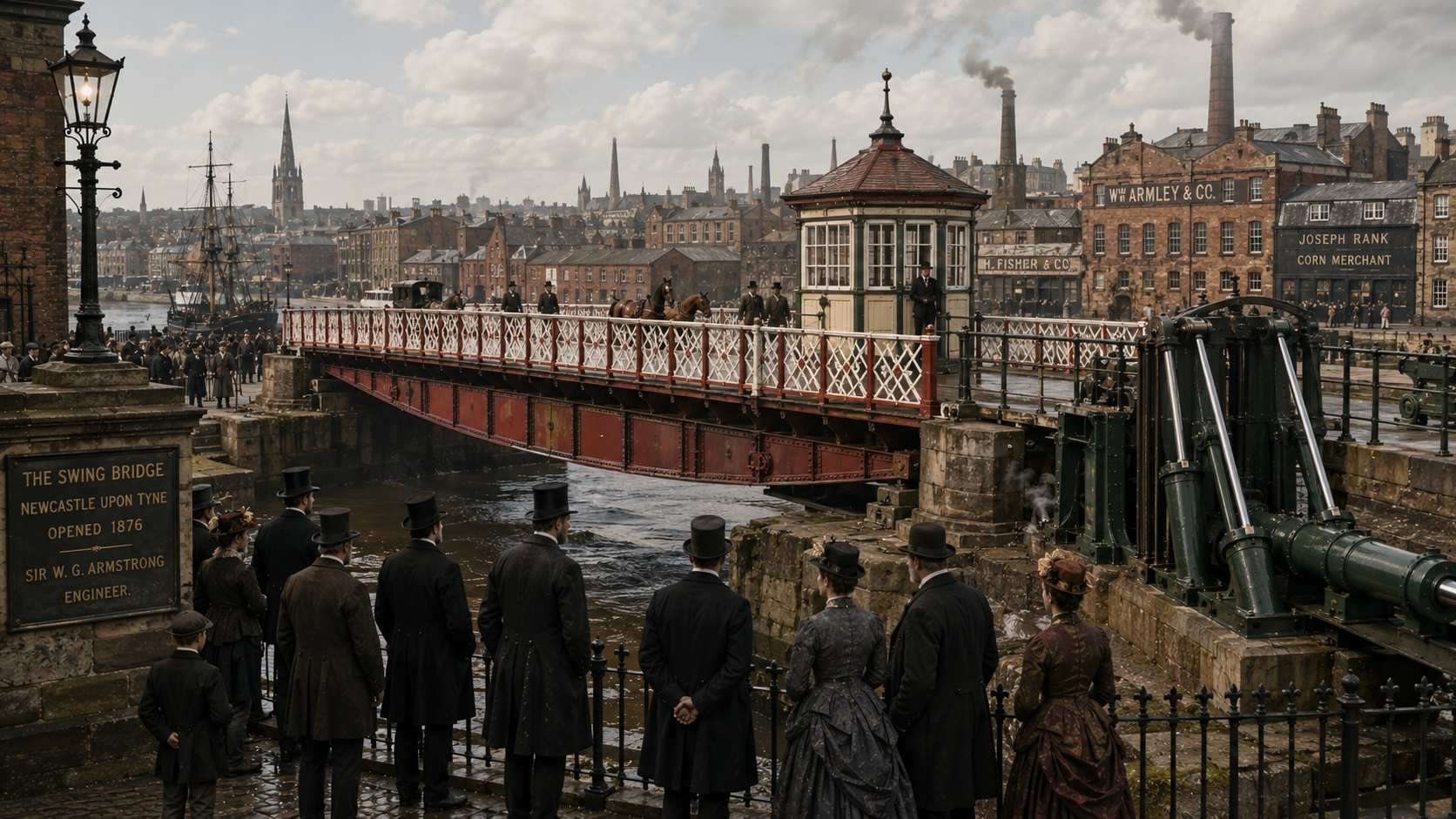
For centuries, every bridge built across the Tyne at Newcastle shared a fundamental limitation: it was fixed, immovable, and consequently a permanent obstacle to any ship too tall to pass beneath it. The Swing Bridge, opened in 1876, finally solved that problem, using exactly the hydraulic technology that had already made its designer, William Armstrong, one of the wealthiest engineers in Britain.
A Bottleneck on a Booming River
By the middle of the nineteenth century, the fixed stone bridge that had replaced the old medieval crossing after the flood of 1771 had become a genuine problem rather than a solution. Newcastle's industrial growth, driven substantially by shipbuilding and heavy engineering firms including Armstrong's own Elswick Works, depended on the ability to move increasingly large vessels up and down the Tyne. A low, fixed bridge at the heart of the city effectively capped how far upriver larger ships could travel, directly limiting the growth of exactly the industries making Newcastle rich.
The solution required a bridge that could move out of the way entirely when needed, then swing back into position to carry road traffic once a ship had passed. That was a considerably more complex engineering challenge than building a conventional fixed crossing, and it fell to William Armstrong, already established as one of the world's leading authorities on hydraulic engineering, to design a structure capable of doing it reliably and repeatedly.
Hydraulic Power in Action
Construction began in September 1868 and was completed in 1876, funded and overseen under the supervision of the Tyne Improvement Commission. The finished bridge used Armstrong's own hydraulic technology, the same fundamental engineering principle behind the cranes that had first made his fortune decades earlier, to rotate its central swinging span smoothly out of the path of river traffic, opening a clear channel for ships to pass through before swinging back into place for road users.
The bridge's swinging span offered a clear waterway on either side once opened, finally giving larger vessels genuine, reliable access to the upper reaches of the Tyne beyond central Newcastle, directly supporting the continued growth of the shipbuilding and heavy engineering firms that had made removing the old fixed bridge such an economic priority in the first place. It was, in a very real sense, infrastructure built specifically to serve Armstrong's own industrial world, a bridge that eased exactly the kind of maritime traffic his other companies depended on.
Built on the Site of History
The Swing Bridge occupies essentially the same crossing point that had been bridged continuously since the Roman fort of Pons Aelius first spanned the Tyne here around AD 122, making it merely the latest, and for over two thousand years the most mechanically sophisticated, answer to the same basic question every previous generation of engineers had faced at this exact spot: how to get people and goods across the river without permanently blocking traffic travelling along it.
That continuity was not lost on Victorian Newcastle. The Swing Bridge's construction required clearing away the last remnants of the old stone bridge that had replaced the medieval crossing, definitively closing the book on centuries of fixed-bridge limitations at this location and opening a genuinely new chapter defined by moving, mechanically powered infrastructure instead.
Still Swinging Today
Remarkably, the Swing Bridge remains in operation today, still capable of rotating open for river traffic using mechanisms directly descended from Armstrong's original nineteenth-century hydraulic system, even as the surrounding bridges, the High Level, the Tyne Bridge, the Millennium Bridge, have each in their own way redefined the Newcastle and Gateshead skyline in the century and a half since it first opened.
For William Armstrong personally, the Swing Bridge represented something more than just another engineering commission. It was a direct, highly visible demonstration of the same hydraulic principles that had built his industrial empire at Elswick, applied this time not to cranes or armaments but to the literal infrastructure of the city that had made his fortune possible, a fitting Victorian monument to an engineer who had spent his entire career finding new, practical applications for the power of moving water.