
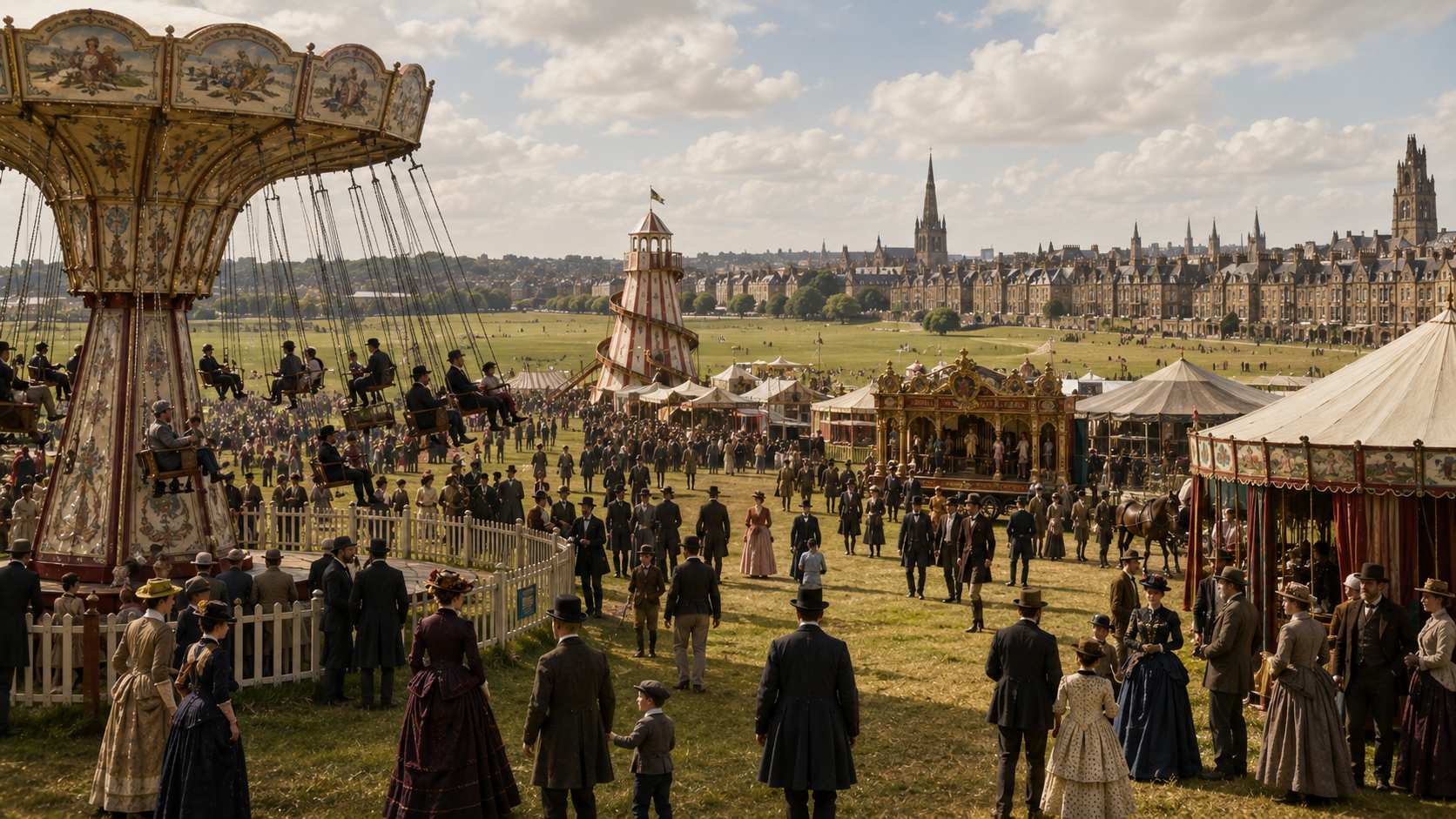
Few British cities can boast a genuine common land larger than their own city centre. Newcastle can. The Town Moor, protected from development for centuries, became during the Victorian era the unlikely home of Europe's largest travelling funfair, an event with surprisingly earnest origins in the temperance movement.
An Ancient Common Newcastle Never Lost
The Town Moor's protection as common land dates back centuries before Victoria's reign, its status maintained through a combination of royal charter, civic custom, and the enduring rights of Newcastle's Freemen, who retain, to this day, the right to graze cattle on the Moor. Covering a substantial area on the northern edge of the city centre, considerably larger than London's Hyde Park and Green Park combined, the Town Moor represents an extraordinary survival: a genuine tract of open common grazing land preserved intact within the boundaries of a major industrial city, resisting the kind of piecemeal development that consumed comparable open spaces in most other rapidly growing Victorian cities.
That survival was never simply accidental. Newcastle's Freemen and civic authorities actively defended the Moor's protected status against repeated development pressure throughout the nineteenth century, recognising its value as both a practical grazing resource and, increasingly as the city industrialised around it, as a rare open, breathable space within an otherwise rapidly urbanising landscape.
A Fair Born From Temperance
The Hoppings, the enormous funfair that now takes over a significant portion of the Town Moor each June, has origins considerably more earnest than its modern reputation for thrill rides and fairground food might suggest. The event grew directly out of the Victorian temperance movement, which campaigned energetically against alcohol consumption and sought to provide working people with wholesome, sober alternative entertainments to the public houses that temperance campaigners viewed as a genuine social scourge.
Newcastle's temperance societies organised the first major Hoppings-style gathering on the Town Moor in 1882, deliberately scheduling the event to coincide with, and effectively compete against, Newcastle's traditional race meeting, an event closely associated with drinking and gambling that temperance campaigners hoped to draw crowds away from. The strategy proved remarkably successful in purely practical terms, even if it never fully displaced the drinking culture it had originally been designed to counter: the Hoppings itself grew rapidly into a major annual fixture in its own right, entirely independent of its original temperance mission.
Growing Into Europe's Largest Travelling Fair
What began as a comparatively modest temperance gathering expanded, across subsequent decades, into what is now widely recognised as the largest travelling funfair in Europe, an annual event drawing showmen, rides and visitors from across the country to set up temporarily on the Town Moor's open ground each summer. The sheer scale the Hoppings eventually achieved would likely have astonished the earnest Victorian temperance campaigners who first organised it, an unintended but genuinely spectacular legacy of their original, considerably more sober ambitions.
That transformation, from pointed temperance alternative to major secular entertainment institution in its own right, mirrors a broader pattern common to many Victorian reform movements: initiatives launched with a specific moral purpose frequently outgrew and outlasted that original mission, evolving into beloved civic traditions valued for reasons that had little to do with the earnest campaigners who first brought them into being.
A Victorian Legacy Still Thriving
The Town Moor itself remains protected common land to this day, its Victorian-era temperance origins now a mostly forgotten footnote to an event now celebrated simply as one of Newcastle's great annual traditions. The Freemen's grazing rights persist alongside the fair, a genuinely unusual coexistence of medieval agricultural custom and modern mass entertainment on the very same stretch of protected urban common land.
Few features of Victorian Newcastle better illustrate how thoroughly the nineteenth century reshaped the city while somehow also preserving pieces of its much older character. The Town Moor's medieval grazing rights survived industrialisation entirely intact, even as a thoroughly Victorian institution, born from earnest moral reform, grew up alongside them into one of the largest events of its kind anywhere in Europe.