
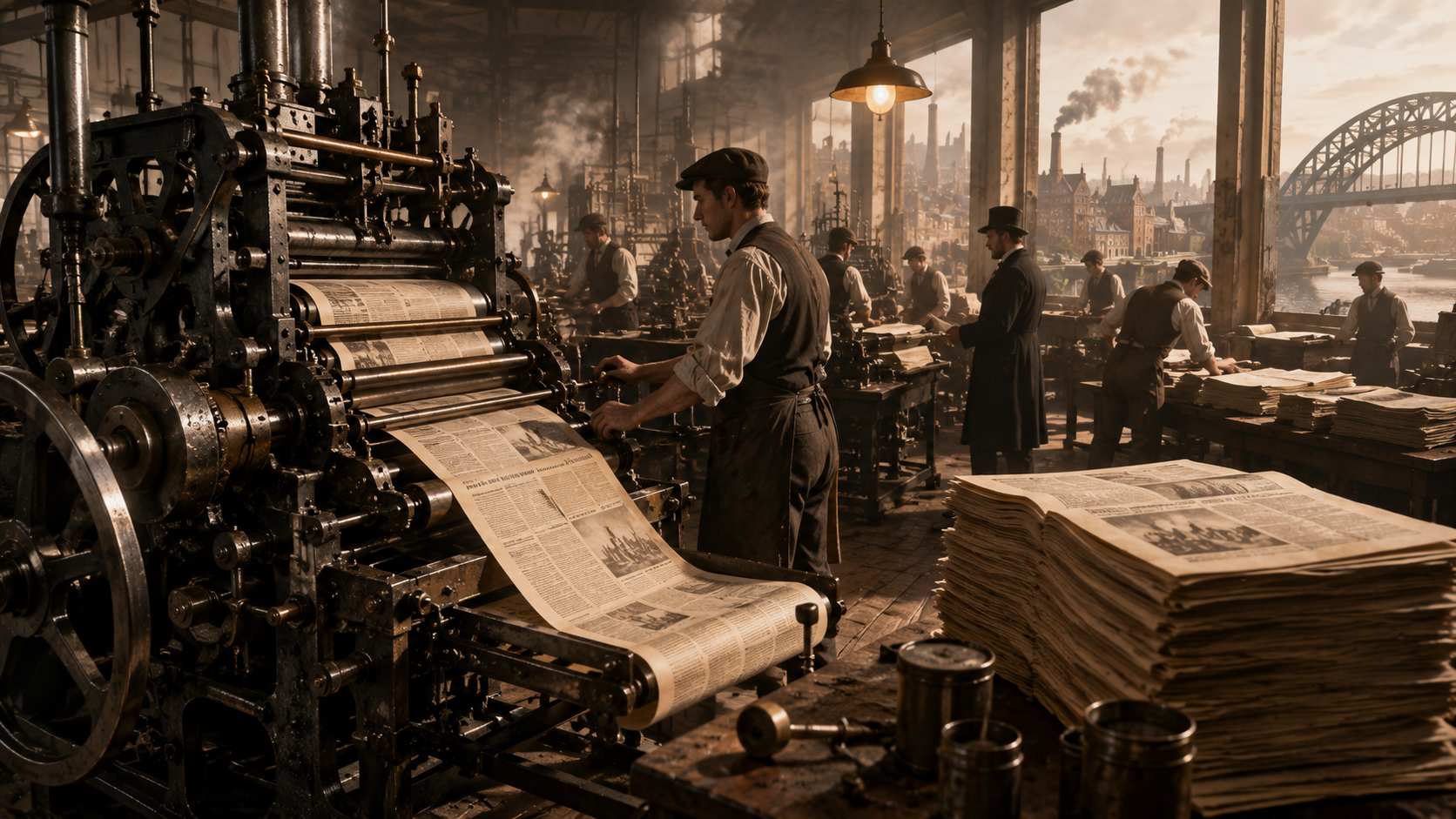
Every major event covered in accounts of Victorian Newcastle, Swan's light bulb demonstrations, the cholera inquiry, the opening of Central Station, was reported, argued over and shaped in real time by a genuinely competitive local press, whose newspapers did far more than simply record the city's transformation. They actively participated in it.
A City That Needed to Read About Itself
Victorian Newcastle's rapid population growth, driven by shipbuilding, heavy engineering and the broader industrial expansion of the Tyne, created a correspondingly rapid growth in demand for local news and information. A city changing this quickly, with new industries, new civic institutions, new infrastructure projects and recurring public health crises all developing simultaneously, generated an enormous appetite among residents for reliable, regular reporting on precisely what was happening in their own rapidly transforming streets.
That demand coincided with genuinely significant technological and legal changes reshaping the newspaper industry across Victorian Britain more broadly. The gradual removal of taxes on newspapers and advertising during the middle decades of the century, combined with improvements in printing technology that made larger print runs considerably more economical, allowed provincial newspapers outside London to expand their circulation and their ambitions considerably beyond what had been commercially viable in earlier decades.
Reporting the City's Own Achievements
Newcastle's Victorian press played a direct, active role in documenting many of the events that now define popular understanding of the city's nineteenth-century transformation. Contemporary newspaper accounts provide much of the surviving detail historians rely on for events like the November 1771 flood that destroyed the old Tyne bridge, described vividly enough by contemporary chroniclers that their accounts remain quoted in historical writing about the disaster to this day, and for the Great Flood's Victorian-era successors and civic responses.
Coverage of Joseph Swan's electric light demonstrations at the Lit and Phil similarly depended on local press reporting to spread news of the achievement beyond the several hundred people who actually witnessed each event firsthand, helping establish Swan's priority claim over Edison in the wider public record through detailed, dated newspaper accounts of exactly what had been demonstrated, and when.
A Voice in Public Health Debates
Newcastle's newspapers also played a genuinely consequential role during the city's recurring Victorian public health crises, publishing detailed accounts of housing conditions in overcrowded districts, reporting on the findings of official inquiries like the 1853 to 1854 Cholera Inquiry Commission, and giving voice to reform campaigners pushing for improved sanitation and housing regulation. This kind of sustained press attention helped keep public health concerns visible to Newcastle's civic authorities and wealthier residents alike, applying exactly the kind of sustained public pressure that gradual Victorian sanitary reform generally required to actually happen.
That combination of civic advocacy and straightforward news reporting reflected a broader pattern common to provincial Victorian journalism: local newspapers rarely functioned as neutral bystanders to their city's development, instead actively campaigning on issues their editors and proprietors considered genuinely important to their readers' welfare and their city's future.
A Press That Helped Build a City's Identity
Beyond straightforward news reporting, Victorian Newcastle's newspapers played a meaningful role in shaping the city's broader sense of its own civic identity and achievements, celebrating local engineering triumphs, promoting civic pride in projects like Grainger's redevelopment and Dobson's Central Station, and helping establish figures like Armstrong and Swan as genuinely celebrated local heroes whose achievements reflected well on the entire city, not merely on the individuals themselves.
That role, part chronicler, part campaigner, part civic cheerleader, made Newcastle's Victorian press an active participant in the city's transformation rather than merely a passive observer recording it from the sidelines. Much of what modern historians and residents alike understand about Victorian Newcastle's achievements survives specifically because contemporary newspapers considered those achievements important enough to report, in detail, at the time they were actually happening.
That surviving record remains genuinely valuable today, well over a century later. Modern accounts of Victorian Newcastle, this one included, depend substantially on exactly the kind of detailed contemporary press coverage that competing local newspapers produced day after day, decade after decade, throughout the nineteenth century, an enormous, largely unglamorous body of local journalism whose real historical value only became fully apparent long after the reporters and editors who produced it had themselves passed into history.