
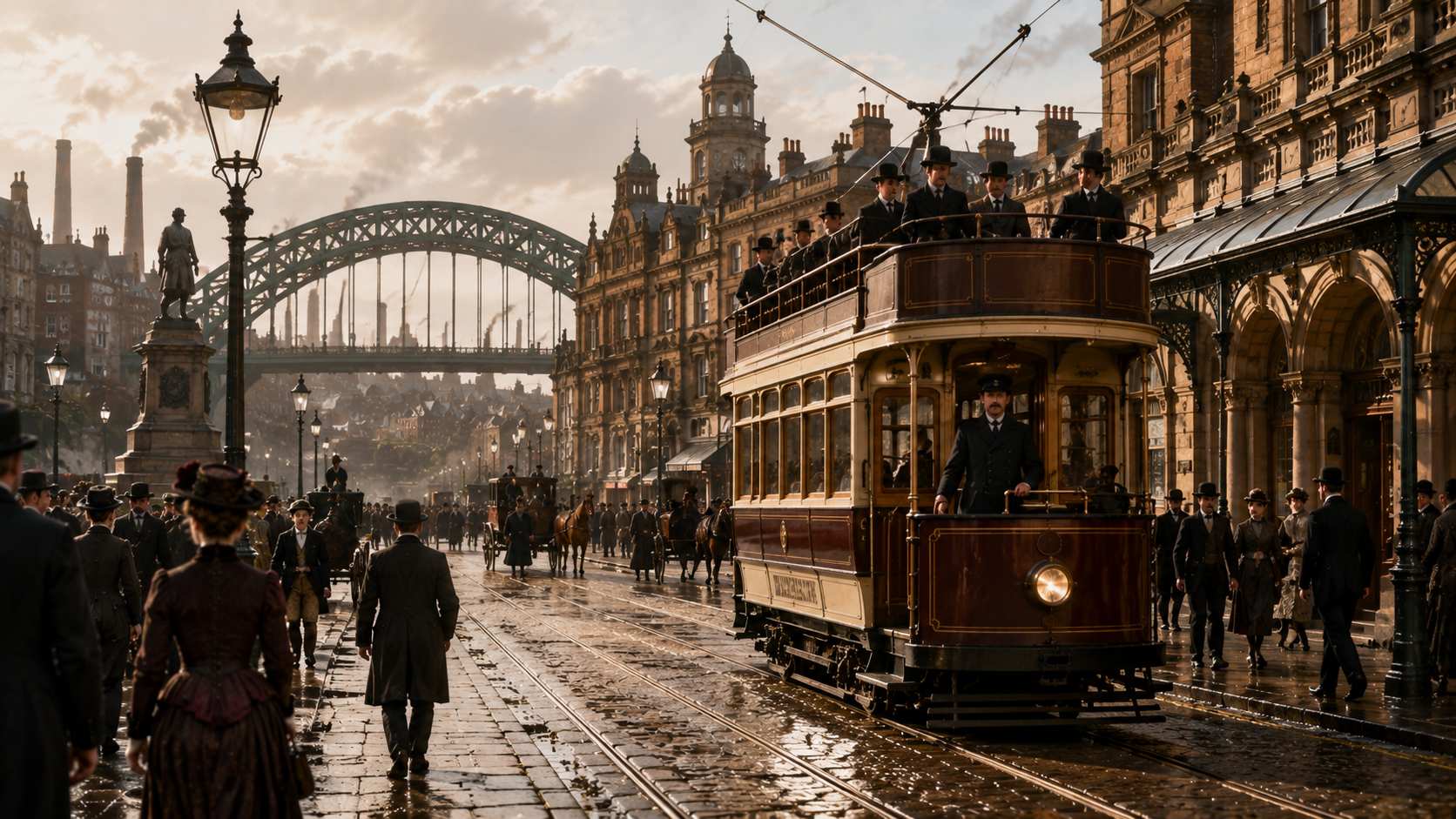
Before trams, Victorian Newcastle's workers were limited to wherever they could reasonably walk. The introduction of tram services during the second half of the nineteenth century fundamentally changed that equation, allowing the city to grow outward in ways simply impossible for a purely pedestrian population.
A City Bound by Walking Distance
For most of Newcastle's history, the practical size of the city was constrained by a simple, unavoidable fact: workers needed to live within reasonable walking distance of wherever they worked, whether at the Quayside's warehouses, Armstrong's Elswick Works, or any of the other industrial and commercial premises driving the city's Victorian growth. That constraint kept Newcastle's residential districts tightly clustered around its industrial and commercial centres, producing exactly the kind of dense, overcrowded housing conditions that had made the city so vulnerable to outbreaks of cholera and other epidemic disease during the mid-nineteenth century.
Breaking that constraint required a genuinely new kind of urban transport, one capable of moving substantial numbers of ordinary working people quickly and affordably between homes and workplaces that no longer needed to sit within comfortable walking distance of each other. Trams, first horse-drawn and later electrically powered, provided exactly that solution, part of a transport revolution transforming cities across Victorian Britain during the closing decades of the nineteenth century.
From Horse Power to Electric Power
Newcastle's earliest tram services, like those in most other British cities during this period, relied on horse-drawn carriages running along fixed rail tracks laid into the street surface, offering a smoother, more comfortable and considerably faster journey than the horse-drawn omnibuses that had preceded them. These horse tram services expanded gradually across Newcastle's growing street network through the later Victorian decades, extending the practical reach of the city for ordinary working residents in ways that had simply not been possible a generation earlier.
The subsequent shift towards electric tram power, part of a technological transition sweeping British cities as the nineteenth century drew to a close, offered substantial further improvements in speed, capacity and operating cost compared to horse-drawn services. Newcastle's own transition towards electric traction, building directly on the city's parallel status as a genuine pioneer in electrical technology through Joseph Swan's own achievements at the Lit and Phil, positioned the city's public transport development within a broader, distinctly Newcastle tradition of embracing electrical innovation early.
Extending the City Outward
The practical consequence of reliable, affordable tram services was a genuine transformation in how Newcastle's population could distribute itself across the wider urban area. Suburbs that would previously have been impractical commuting distances for ordinary working residents suddenly became viable, allowing at least some families the option of moving away from the most overcrowded, unhealthy inner-city districts that public health inquiries had repeatedly identified as dangerous, while still maintaining practical access to city centre employment.
This suburban expansion, enabled directly by tram infrastructure, represented one meaningful, if partial and gradual, response to exactly the housing overcrowding problems that had contributed so directly to Newcastle's mid-century cholera crisis. It was never a complete solution, and considerable urban poverty and overcrowding persisted well into the twentieth century regardless, but the tram network's expansion genuinely did give a growing number of Newcastle's working families new residential options that simply had not existed within living memory.
A Network That Shaped the Modern City
The tram routes established across Newcastle during this Victorian expansion period left a lasting mark on the city's subsequent development, with many of the corridors first opened up by tram infrastructure continuing to function as major transport arteries long after the original tram network itself was eventually replaced by buses and, considerably later, by the modern Tyne and Wear Metro system.
Victorian Newcastle's tram network rarely receives the same dramatic historical attention as Armstrong's bridges or Swan's light bulbs, but its practical impact on ordinary daily life, determining where working families could realistically afford to live, how far they could commute, and how the city's residential geography would ultimately develop, was every bit as transformative as the era's more celebrated engineering achievements.