
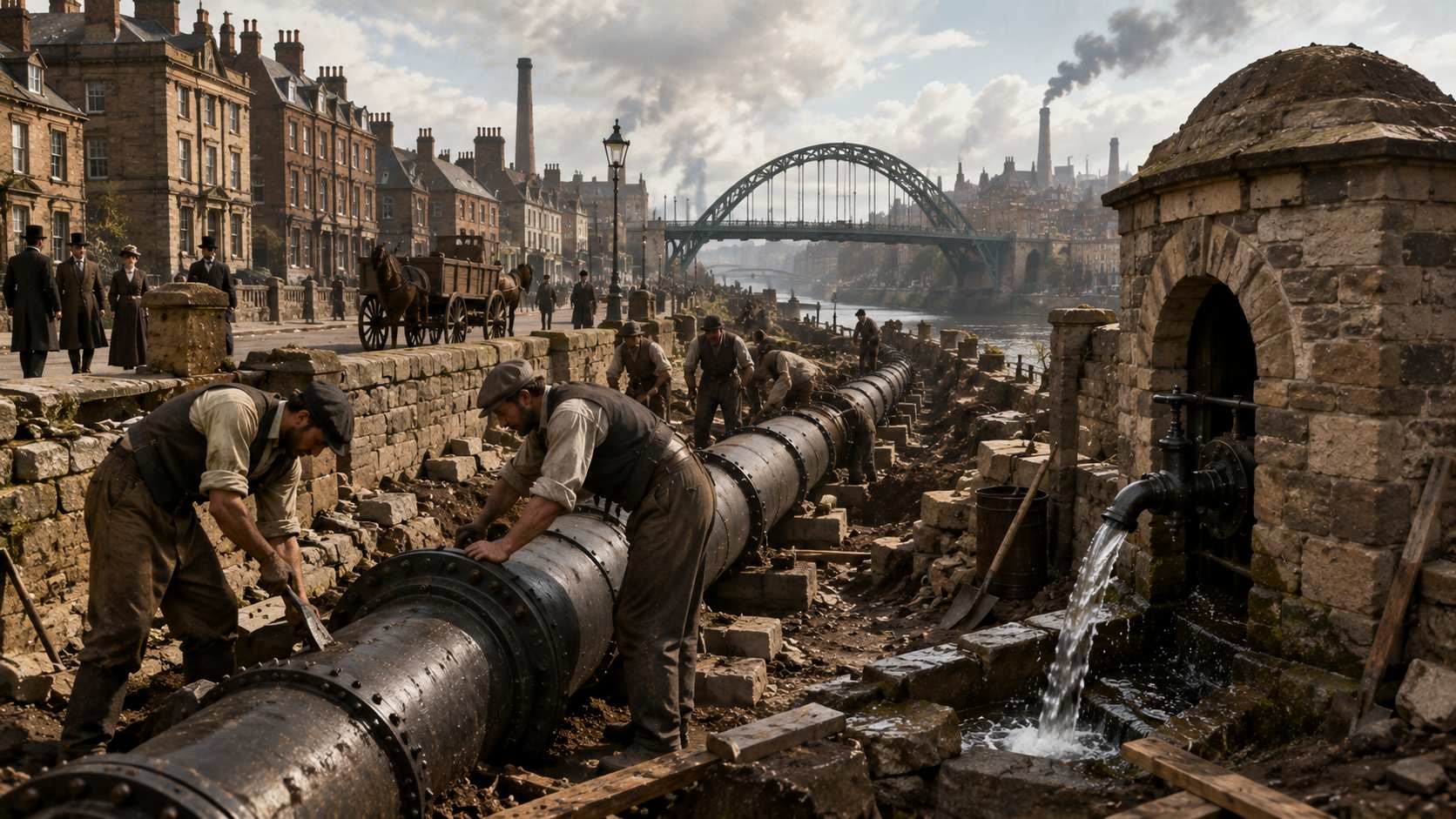
Grand civic architecture and dramatic engineering feats tend to dominate accounts of Victorian Newcastle's transformation. But some of the era's most consequential infrastructure was deliberately invisible, buried underground, built specifically so ordinary residents would never have to think about it: the pipes and reservoirs that finally brought clean, reliable water to a rapidly growing industrial city.
A City That Had Outgrown Its Wells
Newcastle's rapid Victorian-era population growth, driven by shipbuilding, engineering and the broader industrial expansion of the Tyne, placed increasing strain on water supply arrangements that had originally developed to serve a considerably smaller medieval and early modern town. Traditional sources, wells, local springs and the river itself, proved entirely inadequate, and frequently unsafe, for a city whose population and industrial water demands were expanding at a genuinely dramatic pace through the middle decades of the nineteenth century.
The public health consequences of that inadequate supply became starkly apparent during the mid-century cholera outbreaks that repeatedly struck Newcastle and its neighbouring towns, epidemics whose severity official inquiries directly linked to poor sanitation and inadequate access to genuinely clean water, particularly within the city's most overcrowded working-class districts. Solving Newcastle's water supply problem was, by the 1850s, no longer simply a matter of convenience; it had become recognised as a genuine matter of public health and civic survival.
Building the Newcastle and Gateshead Water Company
The Newcastle and Gateshead Water Company emerged as the organisation tasked with solving this problem at genuine scale, constructing the reservoirs, pumping stations and extensive underground pipe networks needed to deliver clean water reliably across both Newcastle and neighbouring Gateshead. This was substantial civil engineering work, typically involving reservoirs constructed some distance from the city itself, in locations where suitable water sources and geography allowed for large-scale collection and storage, connected to the growing city by miles of newly laid pipework.
Water companies undertaking this kind of infrastructure project across Victorian Britain faced consistently difficult technical and financial challenges: securing suitable reservoir sites, negotiating with landowners, raising the substantial capital required for large-scale construction, and managing the ongoing operational complexity of maintaining a growing underground pipe network across an expanding, increasingly densely built-up city. Newcastle's own water infrastructure development followed this same broadly difficult pattern, a multi-decade undertaking rather than any single, quickly completed project.
Invisible Infrastructure, Visible Impact
The genuine public health impact of reliable clean water access is easy to underestimate precisely because effective infrastructure, by its very nature, tends to disappear from public attention once it is working properly. Unlike Newcastle's grand Victorian public buildings, Grey Street, Central Station, the Swing Bridge, water infrastructure earned no dramatic architectural praise and attracted little contemporary comment when it functioned correctly, precisely the outcome its engineers were aiming for.
Yet the public health benefits were genuinely transformative. Reliable access to clean water directly addressed exactly the kind of contaminated supply that had made cholera and other waterborne diseases such a persistent, devastating threat to Victorian Newcastle's poorest, most overcrowded neighbourhoods. Improved water infrastructure, working alongside gradually improving housing regulation and sanitation standards, helped drive the broader decline in epidemic disease that Newcastle experienced across the closing decades of the nineteenth century.
The Unglamorous Backbone of a Modern City
Victorian Newcastle's more celebrated achievements, Armstrong's hydraulics, Swan's electric light, Dobson's grand railway station, all depended, in practical terms, on the same underlying reality: a growing city needed genuinely reliable basic infrastructure, water chief among it, to function at all, regardless of how much dramatic engineering innovation happened above ground. The Newcastle and Gateshead Water Company's reservoirs and pipe networks rarely feature prominently in popular accounts of Victorian Newcastle's transformation, but without them, none of the era's more celebrated achievements would have been sustainable at the scale the city actually achieved.
That is, in many ways, the defining pattern of Victorian civic infrastructure everywhere: the projects that mattered most to ordinary daily life were frequently the ones nobody thought to celebrate at the time, precisely because they were designed to work quietly, reliably, and entirely out of sight.