
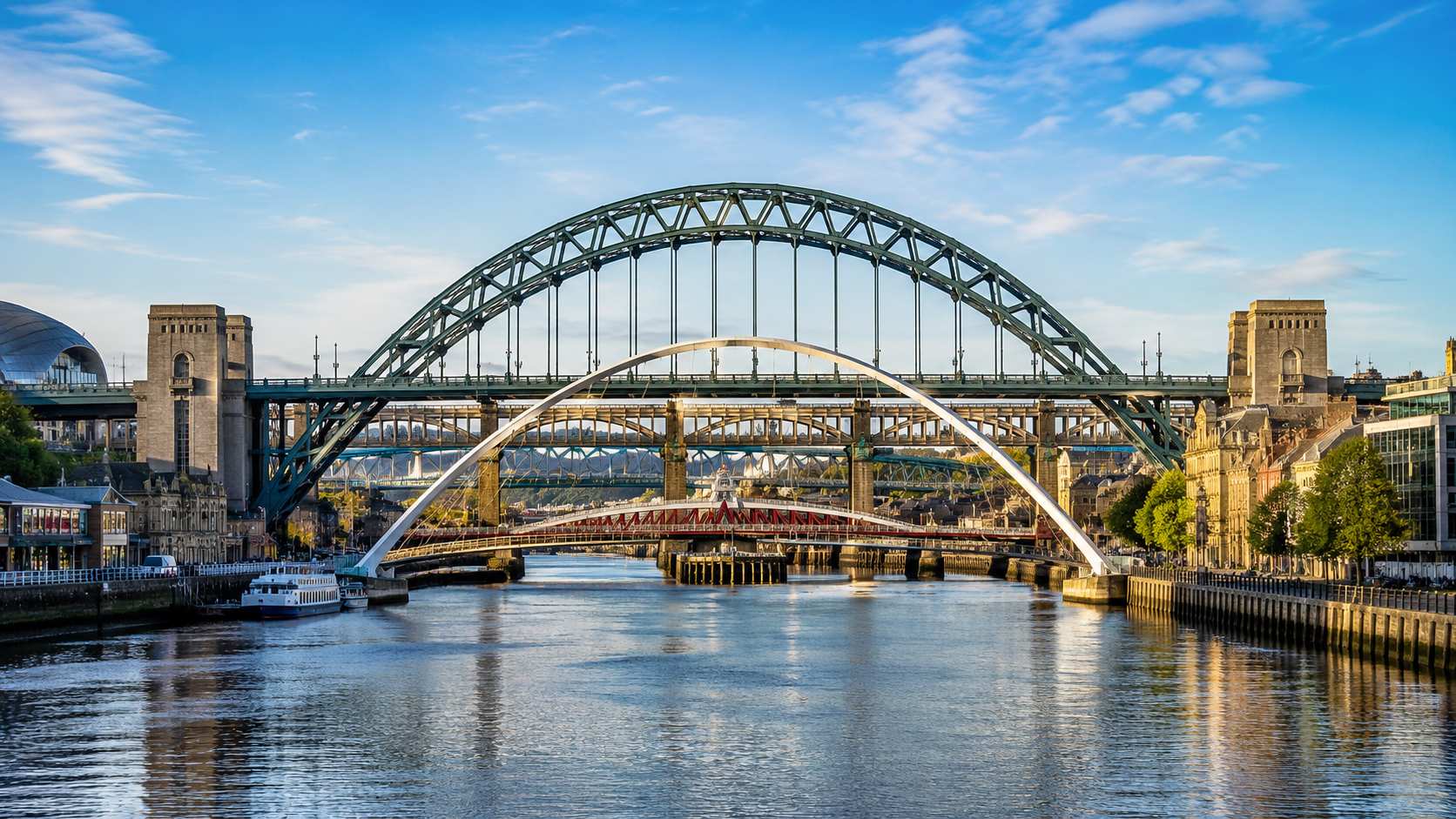
Few short stretches of river anywhere in Britain carry quite as many bridges as the Tyne gorge between Newcastle and Gateshead. Each crossing answers the same basic question, how to get across this particular stretch of water, but each does so using the technology, ambition and priorities of a completely different era.
Where It All Began: The Swing Bridge
The Swing Bridge occupies the site of every previous Tyne crossing at Newcastle, stretching back to the Roman bridge of Pons Aelius around AD 122, through the medieval stone bridge destroyed by flood in 1771, and its eighteenth-century replacement. Opened in 1876 and designed by William Armstrong using his own hydraulic technology, the Swing Bridge solved a problem no earlier fixed crossing ever could: it opens, rotating out of the way entirely to let tall ships pass upriver, a solution still in working operation today, nearly a century and a half after Armstrong first devised it.
The World's First Combined Crossing
A short distance upriver stands the High Level Bridge, designed by Robert Stephenson and opened in 1849 as the world's first bridge to carry both a railway and a public road stacked on separate levels of the same structure. Though no longer part of the main East Coast Main Line, the bridge remains in daily use, its distinctive double-deck silhouette instantly recognisable against the newer crossings that have since grown up around it.
Newcastle's Green Icon
The Tyne Bridge, opened by King George V in 1928, has become Newcastle's single most recognisable symbol, its green steel through-arch design later closely echoed by the far larger Sydney Harbour Bridge, built by the very same contracting firm. At the time of its completion, it stood as the largest single-span bridge in Britain, and its twin granite towers remain a defining feature of the city's skyline, visible from almost anywhere along the Quayside.
Modern Additions to an Ancient Crossing Point
More recent additions have continued the same underlying tradition of solving new transport problems at this same stretch of river. The King Edward VII Bridge, opened in 1906, provided a shorter rail route into Newcastle station. Further downriver, the Redheugh Bridge carries road traffic on a crossing that has itself been rebuilt more than once since its nineteenth-century origins. Most recently, the Gateshead Millennium Bridge, an innovative tilting pedestrian and cycle crossing opened in the early 2000s, gave the regenerated Newcastle and Gateshead quaysides a dedicated pedestrian link entirely separate from road and rail traffic, its distinctive rotating mechanism inspired, in spirit if not literally in engineering, by the same problem-solving tradition Armstrong's Swing Bridge had established over a century earlier.
A Skyline Best Seen From the Water
Each of these crossings was designed to solve a specific, practical problem of its own era, yet together they have become something considerably more than the sum of their individual functions: a genuinely famous skyline, one of the most photographed urban river views anywhere in Britain. Visitors arriving by train across the High Level Bridge, or walking the Quayside at dusk as the Tyne Bridge and Millennium Bridge light up in sequence, are experiencing a view built up gradually, bridge by bridge, across nearly two centuries of continuous engineering ambition rather than any single planned composition.
A River Crossing Nearly Two Thousand Years in the Making
What makes Newcastle's bridges genuinely remarkable, taken together, is not any single crossing but the sheer continuity of the underlying story they tell. From Roman timber and stone, through medieval masonry, Victorian hydraulics and iron, to twentieth-century steel and twenty-first-century tilting mechanisms, engineers have continuously returned to solve the same fundamental problem at essentially the same short stretch of river, each generation building on, or standing beside, the solutions their predecessors left behind.
Walking the Quayside today, with several centuries of bridge engineering visible in a single sweeping view, offers one of the clearest possible illustrations of how Newcastle's entire history has been shaped by this one persistent question: how best to cross the Tyne at exactly this spot.
