
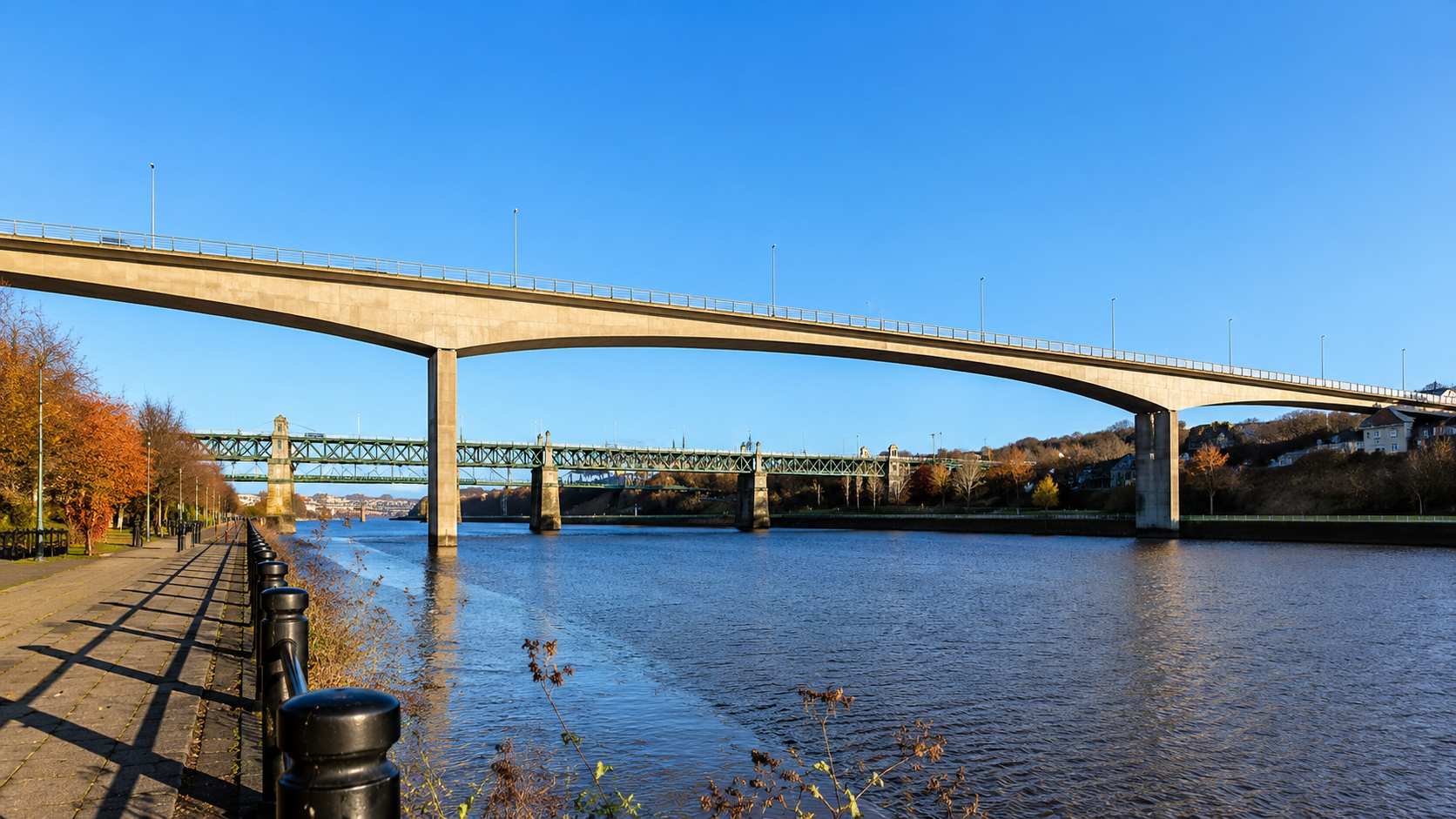
Ask most visitors to name Newcastle's bridges, and the Redheugh rarely makes the list, overshadowed by the more photogenic Tyne Bridge and Swing Bridge nearby. Yet this comparatively unglamorous crossing carries more daily road traffic than any other bridge across the Tyne, and has done the job, in one rebuilt form or another, since 1871.
A Bridge for a Growing Industrial City
The original Redheugh Bridge opened in 1871, built to provide an additional road crossing between Newcastle and Gateshead at a point further west than the historic Swing Bridge crossing, easing pressure on the city's older, increasingly congested central river crossings as Tyneside's industrial economy continued expanding rapidly through the later nineteenth century. Its location, connecting Newcastle's Redheugh district with Gateshead, gave the bridge its lasting name, even as the structure itself would be substantially rebuilt more than once in the decades that followed.
That first Victorian bridge did not survive unchanged for particularly long. Structural concerns and the practical demands of steadily increasing traffic volumes prompted a full replacement bridge, opened considerably later, designed to handle loads and traffic patterns the original nineteenth-century structure had never been engineered to accommodate.
Rebuilt for the Motor Age
The Redheugh Bridge's most significant modern incarnation opened in 1983, a substantial reconstruction reflecting the very different demands of late twentieth-century road traffic compared to the bridge's Victorian origins. This modern structure, built predominantly of concrete rather than the iron and steel favoured by the Tyne's more celebrated nineteenth and early twentieth-century crossings, prioritised practical traffic capacity over the ornamental grandeur that characterises bridges like the Tyne Bridge or High Level Bridge nearby.
That relatively utilitarian approach has, somewhat unfairly, cost the Redheugh Bridge much of the popular recognition its more photogenic neighbours enjoy. Few tourist photographs of Newcastle's famous bridge skyline feature the Redheugh prominently, despite its genuine practical importance to the city's daily transport network.
The Busiest Crossing on the River
Despite its comparatively low public profile, the Redheugh Bridge carries a genuinely significant volume of Newcastle and Gateshead's everyday road traffic, reflecting its practical role connecting major road routes on both banks of the Tyne rather than serving primarily as a pedestrian or ceremonial crossing. For the thousands of commuters and drivers who use it daily, the Redheugh's practical efficiency matters considerably more than the architectural drama that draws visitors to admire the Tyne Bridge from the Quayside below.
That gap between practical importance and public recognition is not unique to the Redheugh among infrastructure more broadly; genuinely essential, heavily used pieces of a city's transport network frequently attract far less popular attention than more visually striking landmarks serving considerably lighter practical loads.
An Overlooked Piece of the Crossing Story
The Redheugh Bridge deserves a place in any complete account of how Newcastle has continually solved the challenge of crossing the Tyne, precisely because its own story, repeated rebuilding to meet changing practical demands rather than a single fixed Victorian or Edwardian design frozen in time, illustrates something the more celebrated bridges nearby do not: that keeping a city moving across its defining river has always been an ongoing, evolving engineering task, not a problem solved once and left unchanged.
Its position slightly apart from the tighter cluster of bridges around the Swing Bridge and Tyne Bridge also gives the Redheugh a somewhat different relationship with the city around it, serving commuters and through-traffic heading further west rather than the tourists and pedestrians who dominate the more central crossings, a genuinely different, equally valid role within Newcastle's wider bridge network. That practical, workhorse character has defined every version of the bridge since 1871, regardless of the materials or engineering standards each successive rebuilding brought with it.
Next time you cross the Tyne on the Redheugh, likely without giving it much thought amid heavier traffic than any of its more famous neighbours carry, it is worth remembering that this quietly essential crossing has been doing exactly this same unglamorous, vital job for well over a century and a half.
