
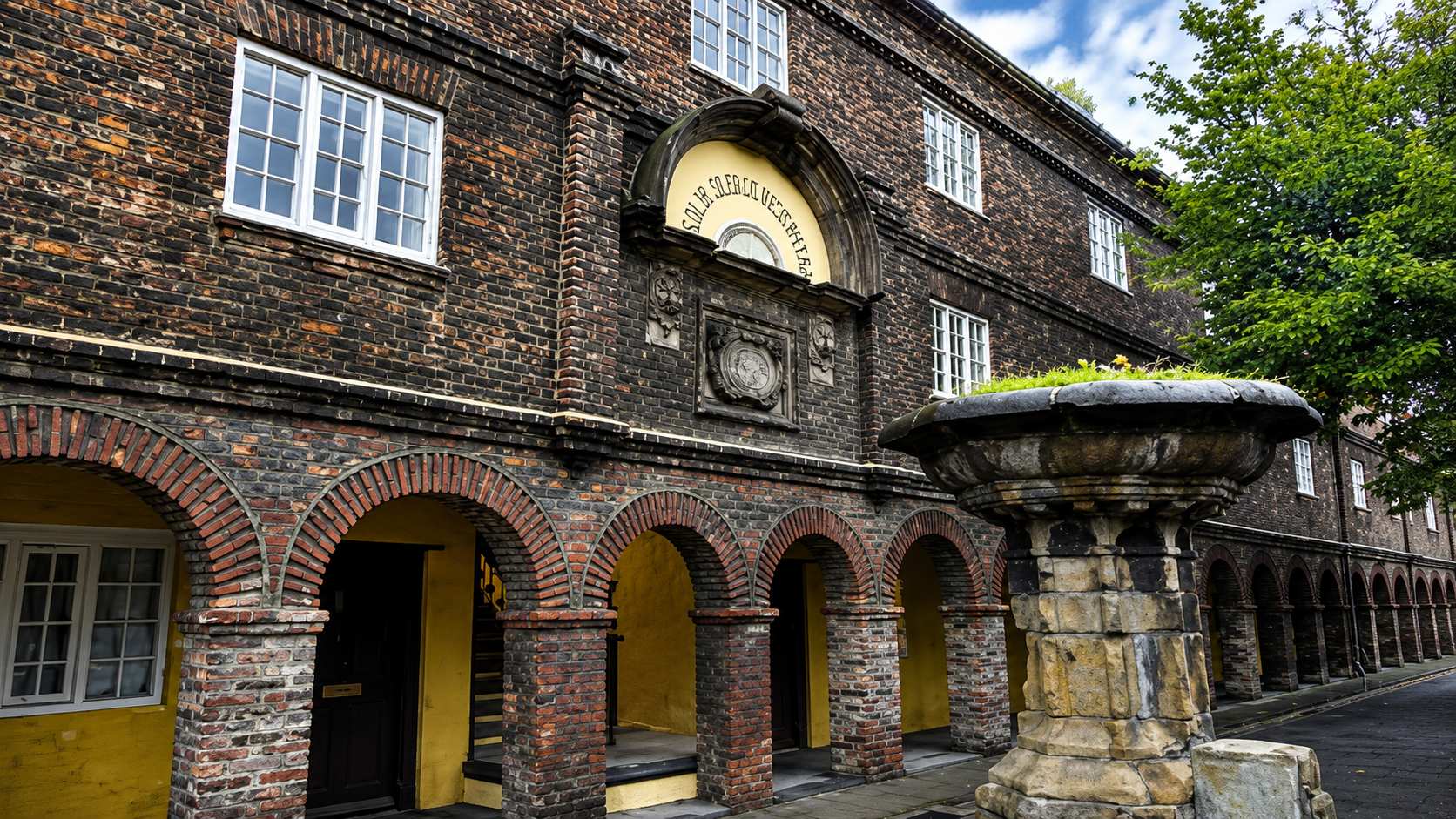
Where Newcastle's Austin Friars once stood, tending to the spiritual needs of the medieval town, a very different kind of institution eventually rose on the same ground: a hospital in the older sense of the word, not a place of medical treatment, but a home caring for the city's elderly poor.
Built on Vanished Monastic Ground
The Holy Jesus Hospital occupies land that once formed part of Newcastle's Austin Friars, one of the five medieval friaries that had operated within the town's walls until Henry VIII's dissolution of the monasteries swept them all away around 1539 and 1540. Like much of the property freed up by the Dissolution, the site eventually found new purpose, in this case as an almshouse, a charitable institution providing housing and basic care for elderly residents unable to support themselves.
That transition, from medieval religious house to early modern charitable institution, was a common pattern across England following the Dissolution, monastic land and buildings frequently repurposed for secular civic or charitable use rather than remaining derelict, even as the specific religious communities that had originally occupied the sites disappeared entirely from English life.
Caring for Newcastle's Elderly Poor
The Holy Jesus Hospital provided precisely the kind of practical social support that towns across pre-industrial England relied on almshouses to deliver, before any formal state welfare system existed to fill that role. Elderly residents unable to work or support themselves independently found shelter, basic provisions and a genuine community within institutions like this one, funded through a combination of civic finance and private charitable bequests from wealthier townspeople keen to secure both practical charitable impact and, frequently, a degree of lasting personal or family commemoration in the process.
This model of charitable almshouse provision, meeting a genuine, urgent social need through voluntary civic and private philanthropy rather than any centralised welfare system, remained the primary mechanism for supporting England's elderly poor for centuries, right through until the gradual development of more formal state-provided welfare arrangements many generations later.
Distinctive Brick Architecture
The Holy Jesus Hospital's surviving architecture reflects its practical, functional purpose as much as any grand civic or religious ambition, built predominantly in brick rather than the stone favoured by Newcastle's more monumental medieval and Georgian landmarks, a material choice reflecting both cost considerations and changing architectural fashions as the building developed across the seventeenth century and beyond. That distinctly different material palette makes the Holy Jesus Hospital visually distinct from much of the stone-built civic and religious architecture surrounding it elsewhere in the city centre.
The building's position, close to the surviving stretch of Newcastle's medieval town wall and within easy reach of the city's other historic religious sites, places it firmly within the same dense concentration of historic institutions that once characterised this part of medieval and early modern Newcastle, even as most of the surrounding friaries and religious houses it once neighboured have long since vanished entirely.
A Quieter Chapter in Newcastle's Charitable History
The Holy Jesus Hospital rarely receives the same public attention as Newcastle's grander medieval and Victorian landmarks, the Castle, the Cathedral, Grey Street's neoclassical sweep. Yet its centuries of quiet, practical charitable work, sheltering generations of elderly Novocastrians who might otherwise have faced genuine hardship, represents an essential, if less visually dramatic, thread within the city's much longer story.
That relative obscurity is, in its own way, entirely fitting for a building whose original purpose was never to impress or draw attention, but simply to provide reliable, unglamorous shelter to people the wider town might otherwise have overlooked entirely, a quietly important civic function carried out with far less fanfare than the grander landmarks surrounding it.
Built quite literally on the foundations of a vanished medieval friary, the hospital's own history captures something genuine about how Newcastle repeatedly found new civic purposes for old religious ground, converting the physical legacy of the Dissolution into practical, ongoing charitable benefit for generations of the city's most vulnerable residents.
