
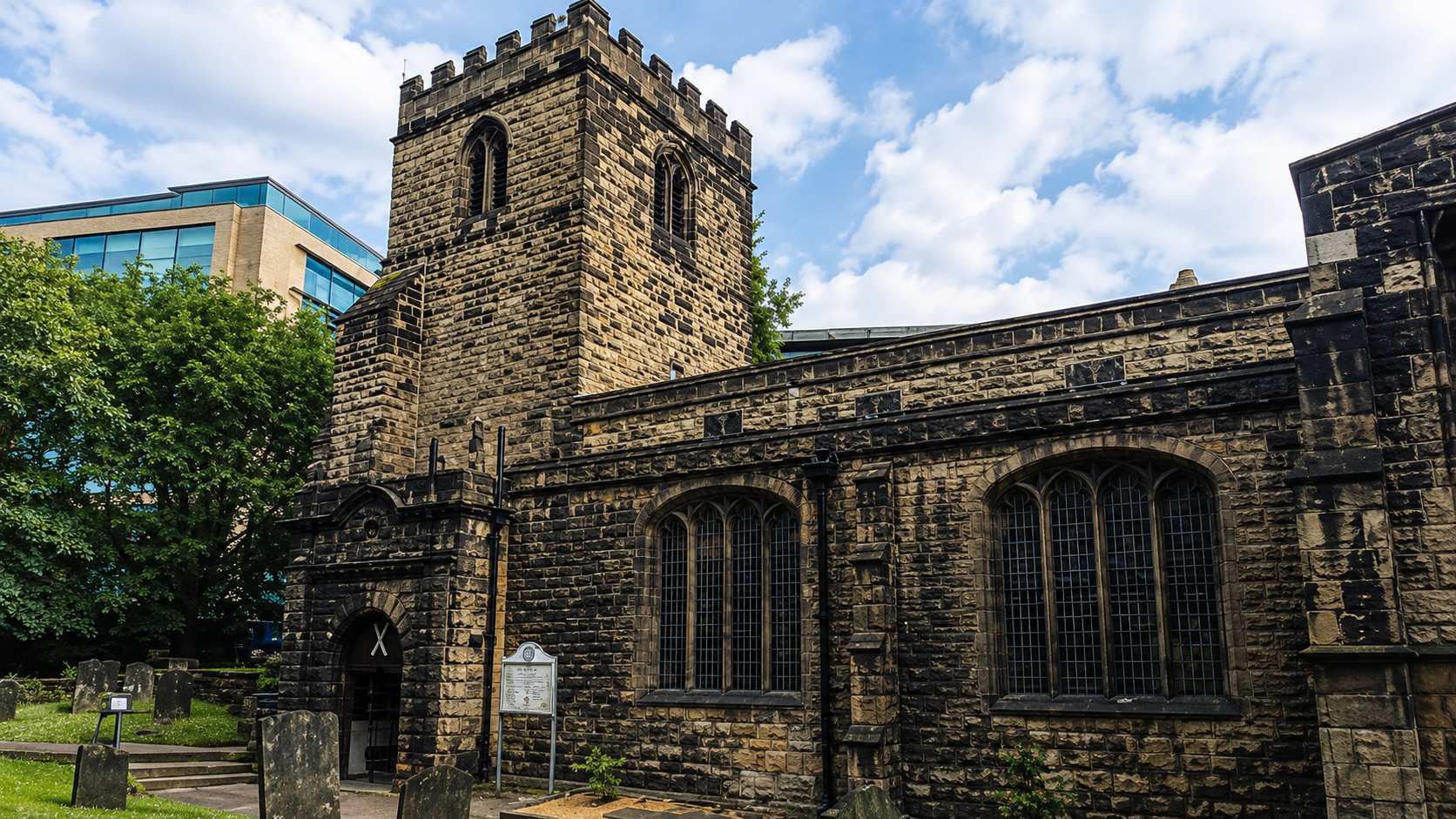
Newgate Street hides one of Newcastle's most genuinely tranquil spaces behind an unassuming iron gate: a quiet churchyard surrounding a building widely regarded, though not entirely without dispute, as the oldest church anywhere in the city.
A Contested but Compelling Claim
St Andrew's Church dates from the twelfth century, with its earliest surviving masonry, a decorated Norman chancel arch, semicircular arches on round columns, and the lower portion of its west tower, generally dated to the mid to late 1100s. Local tradition has long held St Andrew's to be Newcastle's oldest church, a claim traditionally linked to the Scottish king David I, though the historical evidence for that specific royal connection remains genuinely uncertain.
The claim to oldest status is not entirely uncontested; St John the Baptist Church, built around 1130, offers a rival candidate, and a 2002 geophysical survey at St Andrew's identified traces of an even earlier, pre-Conquest structure beneath the current building, complicating any simple, definitive answer. What can be said with confidence is that St Andrew's incorporates genuinely ancient fabric, including reused Roman material within its tower stonework, a physical link back to the city's very earliest history stretching back well before the church's own twelfth-century origins.
Growing Alongside the Medieval Town
St Andrew's expanded steadily through the medieval period as Newcastle itself grew, with new north and south transepts, a widened north aisle, a lengthened chancel and an enlarged tower all added by around 1300, followed by a fourteenth-century south porch and the addition of the Trinity Chapel. That pattern of continuous medieval expansion mirrors the town's own growing prosperity during the same period, a parish church whose physical growth tracked the wealth and population of the community it served.
The church's position, immediately beside a substantial surviving section of Newcastle's medieval town wall, and close to where the imposing New Gate once stood until its demolition in 1823, places St Andrew's directly within the city's medieval defensive landscape, a rare spot where visitors can still appreciate genuine fragments of both the town's religious and military architecture standing together.
Surviving a Civil War Siege
St Andrew's did not escape the destructive nine-week siege of Newcastle in 1644 unscathed. The church suffered sufficiently severe damage during the conflict that services were suspended entirely for more than a year afterwards, evidence of just how directly the fighting affected this particular corner of the town, positioned as it was close to the town wall that Scottish besieging forces spent weeks attempting to breach.
Subsequent centuries brought further alteration rather than any single dramatic restoration. The church's porch was rebuilt in 1726, and in 1844 the accomplished local architect John Dobson, already responsible for so much of Newcastle's Georgian and Victorian civic architecture, added a new south transept, its three semi-circular windows and delicate decorative filigree work deliberately designed to complement the church's much older medieval fabric rather than overwhelm it.
A Peaceful Survivor in a Busy City
St Andrew's churchyard today remains a genuinely peaceful retreat within Newcastle's busy city centre, its ancient gravestones and mature trees offering a quiet contrast to the surrounding streets. The composer Charles Avison, born in Newcastle and celebrated as one of the finest exponents of the concerto grosso form in eighteenth-century England, was buried here in 1795, one of several notable Novocastrians whose final resting place lies within these grounds.
Information panels dotted around the church and its grounds set out the various phases of construction and repair in more detail than a casual visitor might expect from such a modest, easily missed building, rewarding anyone willing to slow down and actually read them rather than simply passing through on the way to somewhere else in the city centre.
Whatever the precise final verdict on Newcastle's "oldest church" title, St Andrew's undeniable age, its genuine Norman stonework, its scars from civil war, and its centuries of continuous parish life, make it one of the most historically rich, and most easily overlooked, buildings in the entire city centre.
