
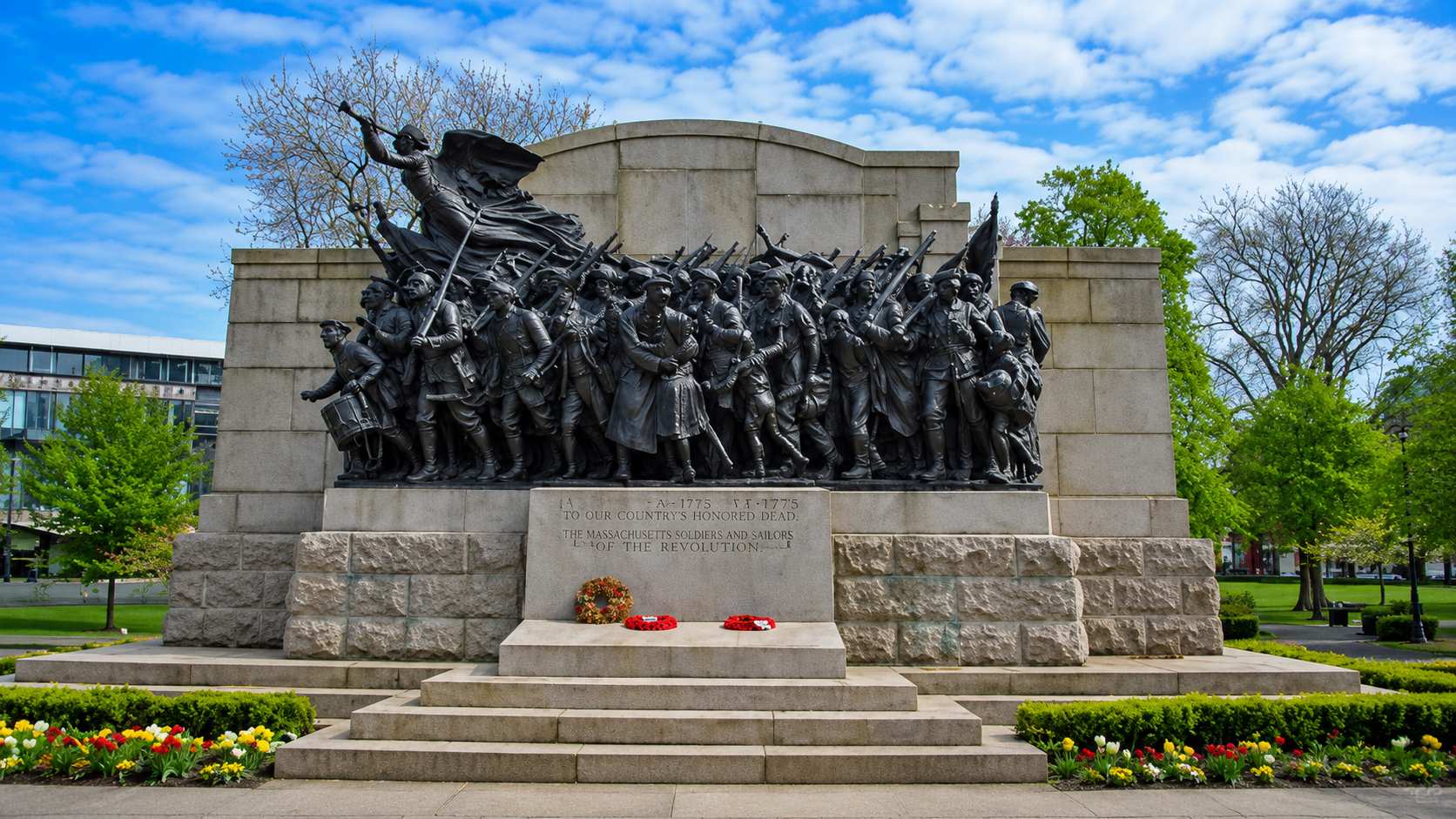
Most war memorials commemorate loss after the fact, names carved in stone once the fighting has ended. Newcastle's principal First World War memorial does something different: it captures the moment of departure itself, volunteers stepping forward to answer their country's call before anyone yet knew what the war ahead would actually cost.
Capturing a Moment of Decision
The Response memorial depicts the outbreak of recruitment in August 1914, when men across Tyneside, like across the whole of Britain, queued to volunteer for military service in the belief, widely shared at the time, that the coming conflict would be brief and quickly decided. Rather than a simple commemorative statue or an abstract monument, the memorial presents a genuinely detailed narrative scene, soldiers and civilian well-wishers captured together in bronze, a snapshot of that specific, historically pivotal moment before the full scale of the war's eventual human cost had become apparent to anyone involved.
That choice of subject, the moment of eager volunteering rather than the grief of loss, reflects the particular emotional and civic mood in which the memorial was conceived and funded, a period when Britain's understanding of the war's true nature was still being formed, even as the memorial itself would not actually be completed and unveiled until years after the conflict's end.
A Prominent Civic Location
The memorial stands at Barras Bridge, a prominent junction near Newcastle's civic and cultural quarter, positioned to be genuinely visible and accessible to the wider public rather than tucked away in a quieter, less frequented corner of the city. That deliberate prominence reflects the genuinely significant civic importance Newcastle, like towns and cities across Britain, attached to commemorating the First World War's local impact once the full human cost of the conflict had become devastatingly clear.
Tyneside's contribution to, and losses during, the First World War were substantial, reflecting the region's significant industrial contribution to the war effort through shipbuilding, armaments manufacture and coal production, alongside the very direct human cost paid by the thousands of local men who served, and in many cases died, during the conflict. A memorial of this scale and prominence reflected the genuine, widely shared civic determination that such sacrifice should be permanently, publicly remembered.
Sculpture as Historical Narrative
The Response's detailed narrative approach, depicting a specific historical moment with genuine figurative precision rather than relying on more abstract or purely symbolic memorial forms, was a deliberate artistic choice, giving the monument a documentary quality distinct from many comparable war memorials erected across Britain during the same period. Visitors encountering the memorial today can read it almost as a frozen historical scene, individual figures each telling their own small part of the larger story of Tyneside's response to the outbreak of war.
That narrative specificity has helped the memorial retain its emotional power across more than a century since the events it depicts, offering later generations a genuinely vivid, humanised connection to a moment that might otherwise remain abstract, a distant historical event rather than a lived experience involving real individuals making a genuinely consequential personal decision.
A Monument That Still Resonates
The Response remains one of Newcastle's most significant public monuments, a permanent, prominently sited reminder of the First World War's profound impact on Tyneside and its people. Unlike memorials that simply list names, its detailed narrative scene invites viewers to imagine themselves within the specific historical moment depicted, standing among the volunteers and well-wishers captured in bronze at Barras Bridge, queuing to answer a call whose true, terrible cost none of them could yet have fully understood.
Remembrance events continue to gather at the memorial each November, an unbroken thread of public commemoration stretching back across more than a century, connecting each new generation of Novocastrians to the same bronze figures who have stood, permanently mid-step, at this Barras Bridge junction since the memorial's original unveiling. Few monuments anywhere in the city achieve quite the same balance of historical specificity and lasting emotional resonance.
