
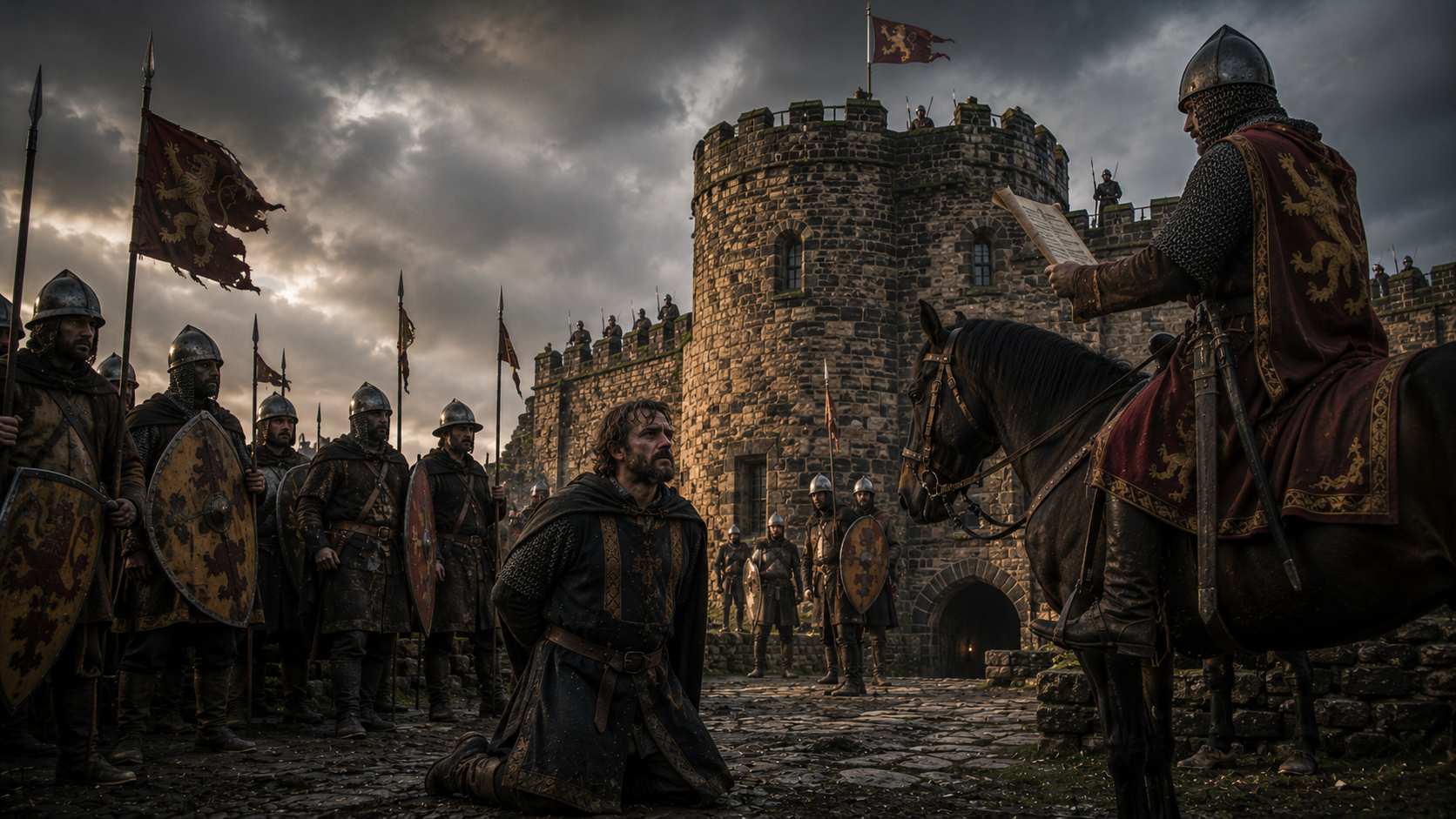
Newcastle Castle might easily have remained a comparatively minor baronial stronghold rather than a genuine seat of royal power, had one ambitious Earl of Northumbria not badly miscalculated his own political standing in 1095.
A Wooden Castle in Baronial Hands
The original timber motte-and-bailey castle built by Robert Curthose in 1080 had, for its first fifteen years, existed under a somewhat ambiguous ownership arrangement, a royal foundation but not necessarily a permanently, exclusively royal possession in the way the later stone castle would become. Robert de Mowbray, Earl of Northumbria, held considerable regional authority during this period, his position giving him substantial practical influence over castles and fortifications across the wider region, Newcastle very much included.
That arrangement changed decisively, and permanently, when Mowbray made a serious political misjudgement: rising in open rebellion against King William Rufus, William the Conqueror's son and successor, in 1095.
An Earl's Fatal Miscalculation
Mowbray's rebellion reflected the genuinely turbulent, frequently violent politics of Norman England during this period, when powerful regional magnates regularly weighed their own ambitions against the always-uncertain security of royal favour. Whatever specific grievances or ambitions drove Mowbray's decision to openly defy his king, the practical consequences proved swift and entirely one-sided: William Rufus dispatched a royal army north specifically to crush the rebellion and reassert direct crown authority over the contested region.
That royal military response inevitably focused on the region's key strongholds, Newcastle's own castle prominent among them, given its strategic position controlling the vital Tyne crossing and its role as a genuine centre of regional power. The castle was captured as part of the wider suppression of Mowbray's revolt, bringing his brief period of rebellion, and his broader regional authority, to a decisive and permanent end.
A Permanent Change of Ownership
The rebellion's suppression had a genuinely lasting consequence for Newcastle Castle specifically: from 1095 onwards, the castle became crown property outright, rather than remaining under any form of baronial or earl-level control that might, under different circumstances, have proven more temporary or contested. That permanent royal ownership gave successive English monarchs direct, ongoing authority over one of their most strategically significant northern strongholds, a crucial base from which the crown could monitor and, when necessary, directly control the sometimes fractious northern barons whose loyalty could never be entirely taken for granted.
This shift from baronial to permanent royal control set the pattern for everything that followed at the site. Henry II's decision, some eight decades later, to invest such substantial royal resources rebuilding the castle in stone between 1172 and 1177 makes considerably more sense within this context: by that point, Newcastle Castle was unambiguously crown property, a royal fortress worth the kind of major capital investment a monarch would be considerably less inclined to make in a stronghold whose ultimate ownership remained genuinely contested or merely borrowed from a regional earl.
A Rebellion's Long Shadow
Robert de Mowbray's own personal fate after his rebellion's failure was considerably grimmer than the castle's own subsequent fortunes; contemporary accounts suggest he spent years imprisoned following his defeat, a stark personal consequence for backing the losing side in a Norman succession dispute. But the castle whose capture had helped crush his revolt went on to a far longer and more consequential future, its permanent transfer into direct royal hands in 1095 setting the stage for the substantial stone fortress, and the centuries of continued royal and civic significance, that would eventually follow.
It is worth pausing on just how contingent this outcome actually was. Had Mowbray's rebellion somehow succeeded, or had he simply chosen not to rebel at all, Newcastle Castle might easily have remained a comparatively minor regional fortification rather than the substantial royal stronghold Henry II later invested so heavily in rebuilding.
Few individual events in Newcastle Castle's long history did more to shape its subsequent trajectory than this one failed regional rebellion, a reminder that even a fortress's most solid stone walls often owe their ultimate origins to considerably more fragile, contingent political events.
