
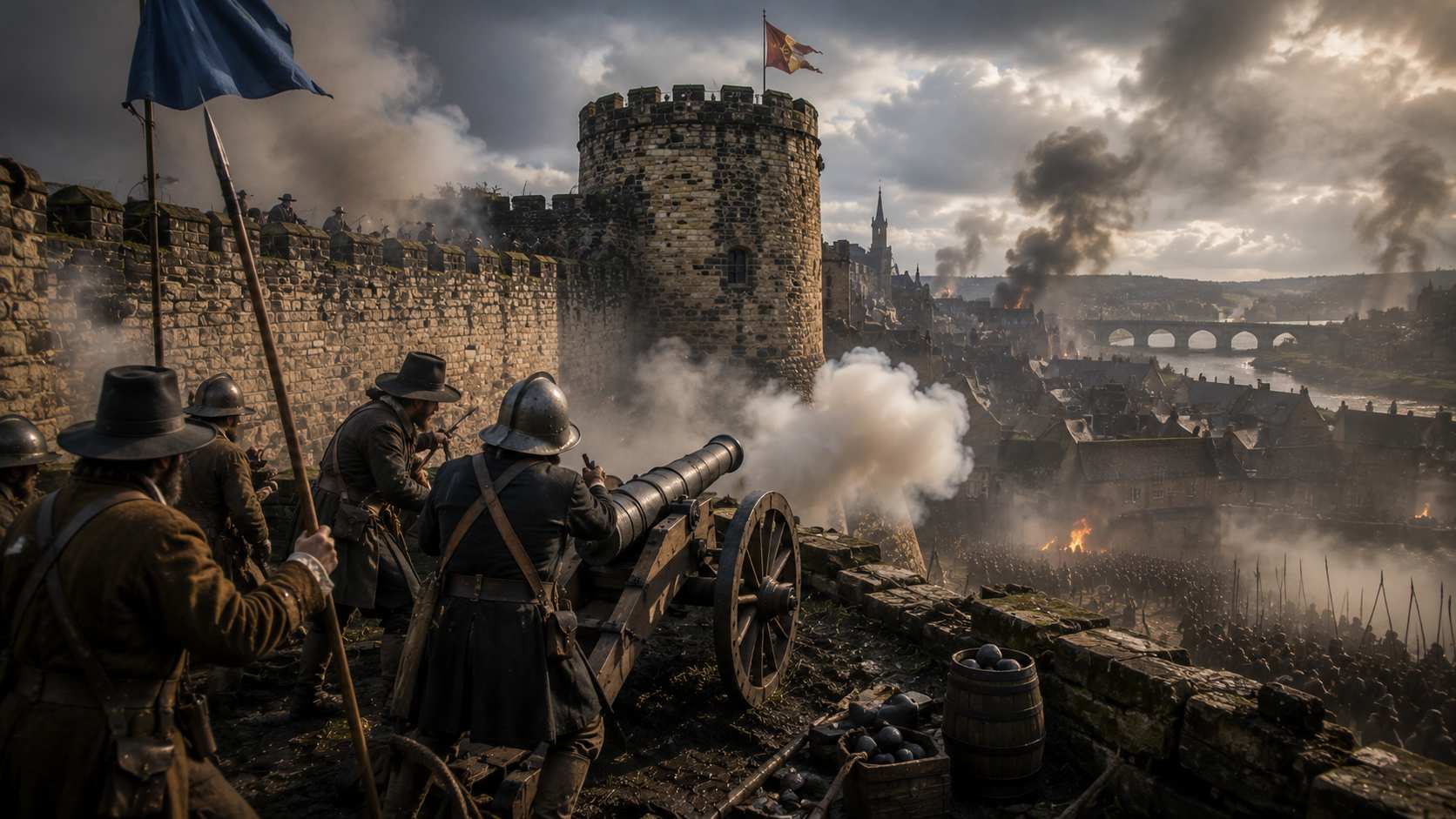
By the time Scottish forces laid siege to Newcastle in 1644, the castle that had given the city its name was no longer the cutting edge of military engineering it had once been. Nearly five centuries old, and superseded in strategic importance by the town's own more extensive medieval walls, it nonetheless still had a part to play when the fighting finally arrived.
A Castle Overtaken by the Town Wall
By the seventeenth century, Newcastle Castle's original defensive purpose had been substantially superseded by the town's own encircling medieval wall, constructed from the mid-thirteenth century onwards specifically to protect the wider trading settlement that had grown up around, but ultimately extended well beyond, the castle's own original fortified footprint. The castle itself sat outside the formal line of the town wall entirely, its own defences essentially a separate, older fortification rather than a fully integrated component of the town's primary seventeenth-century defensive system.
That positioning meant the castle's role during the 1644 siege was necessarily secondary to the town wall itself, which bore the primary weight of the nine-week Scottish siege that eventually forced Newcastle's Royalist defenders to surrender.
A Nine-Week Siege
The wider siege of Newcastle in 1644 formed part of the broader English Civil War, with a Scottish army allied to Parliamentary forces besieging the town, which had declared for the Royalist cause. The siege lasted approximately nine weeks, a sustained, gruelling campaign that ultimately succeeded when Scottish forces breached the town wall using mines and artillery, a serious military achievement given the wall's own centuries of accumulated defensive strength.
Newcastle's Royalist mayor, Sir John Marley, coordinated the town's defence throughout the siege, employing whatever measures were available to delay the inevitable, including, at St Nicholas' Church nearby, the well-documented tactic of housing Scottish prisoners within the church's lantern tower specifically to deter Scottish artillery from targeting the structure directly.
A Fortress Still Standing, If No Longer Central
Whether the castle itself came under direct, sustained attack during the siege, or served primarily as a secondary strongpoint and refuge once the town wall had finally been breached, its thick stone walls, dating back to Henry II's twelfth-century construction, would have remained a genuinely formidable structure regardless of its reduced strategic centrality compared to the town's own more extensive fortifications. Even an ageing, partially superseded medieval keep represented substantial defensive capability by seventeenth-century standards, its walls considerably thicker and more resistant to period artillery than most contemporary buildings.
The castle's survival through the siege, unlike some sections of the town wall itself, which suffered permanent damage during the fighting, reflects both its inherent structural resilience and its comparatively secondary role in the overall battle for the town, a fortress substantial enough to endure the conflict without becoming the primary focus of the fighting that ultimately determined Newcastle's fate.
A Reminder of Shifting Military Priorities
The castle's relatively minor role in 1644, compared to its central importance during the medieval Scottish border wars several centuries earlier, illustrates how thoroughly military priorities and defensive technology had shifted since Henry II first built his stone keep. What had once been Newcastle's absolute defensive centrepiece had, by the seventeenth century, become one defensive asset among several, its historic bulk still useful but no longer the single most critical structure standing between the town and a besieging army.
Archaeological excavation near the Black Gate has uncovered physical evidence of the castle's continued seventeenth-century defensive adaptation, including a pit specifically associated with Civil War-era defences, confirming that the site was still being actively modified for military purposes even this late in its working life, rather than simply standing idle while the town wall did all the fighting.
That gradual shift in strategic importance, from primary stronghold to secondary fortification, mirrors the castle's own broader story across the centuries that followed the siege, a structure whose military relevance would continue fading even as its historical and civic significance to Newcastle only grew stronger with each passing generation.
