
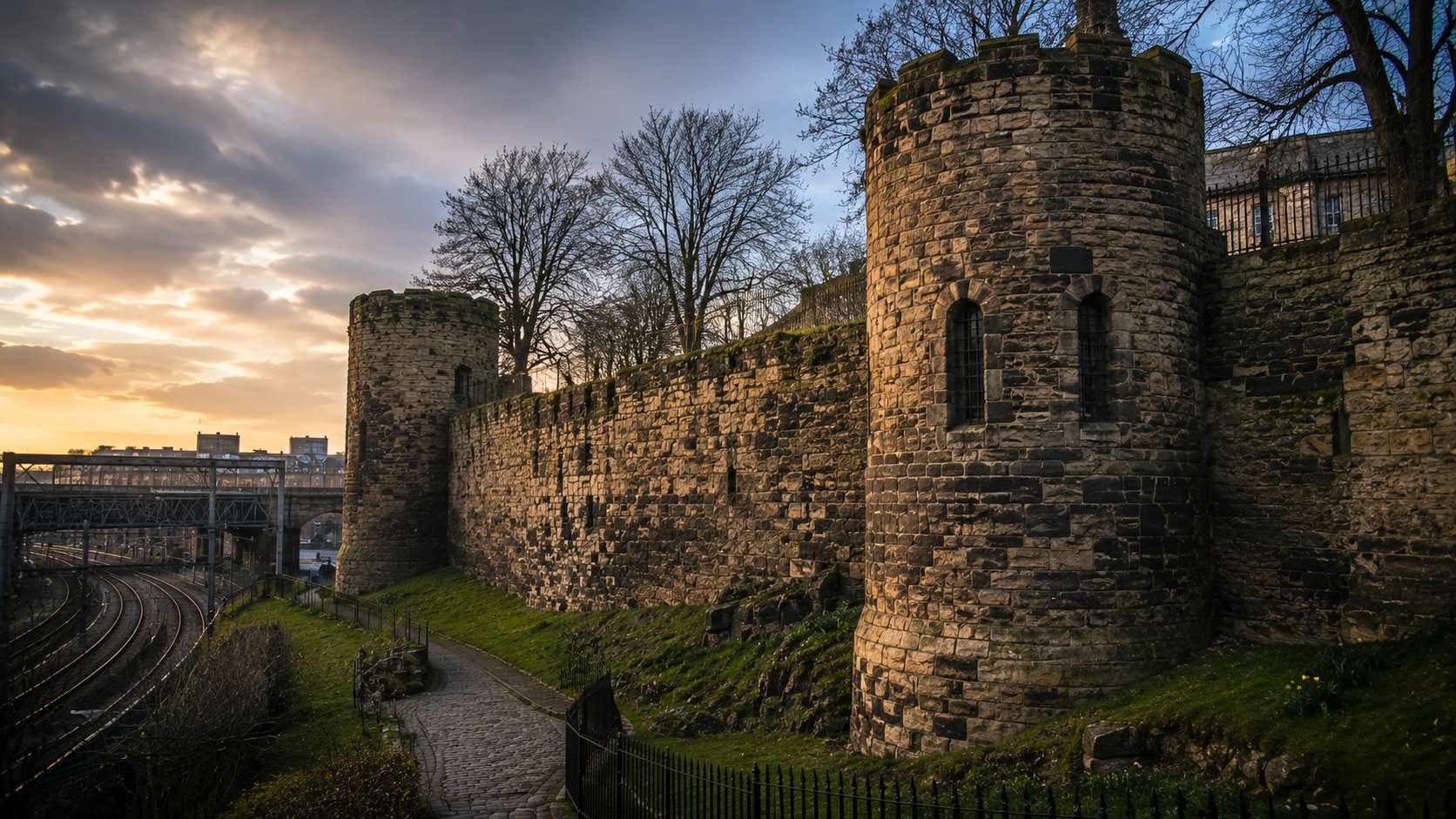
Newcastle Castle once stood within a substantial ring of outer defences, a curtain wall studded with towers enclosing a considerably larger footprint than the surviving Keep and Black Gate alone might suggest today. Most of that outer wall is gone entirely, but a determined visitor can still find genuine fragments if they know exactly where to look.
A Fortress Larger Than It Appears Today
Medieval Newcastle Castle was never simply the Keep and Black Gate visitors encounter today; those two structures represented the innermost, most heavily fortified core of a considerably larger defensive complex, enclosed by an outer curtain wall studded with additional towers and defended gateways. That wider defensive perimeter enclosed the castle's inner bailey, providing an additional layer of defence beyond the Keep's own already formidable thick stone walls.
Understanding this larger original footprint helps explain why the modern Castle Garth precinct, the area historically enclosed within these outer walls, extends considerably beyond the Keep and Black Gate's immediate footprint, even though most of the actual wall that once defined that boundary has long since vanished.
Lost to the Railway
The Victorian railway construction of the 1840s dealt the castle's outer curtain wall its most devastating blow. As part of the compromise that saved the Keep and Black Gate from outright demolition in 1847, campaigners were unable to prevent the loss of most of the surrounding curtain wall itself, cleared to make way for the new railway viaduct and its approach routes. That loss, while considerably less significant than losing the Keep and Black Gate would have been, still represented a genuine, permanent reduction in how much of the original medieval fortress survives intact today.
Comparing Newcastle Castle's current visible footprint against historical plans and descriptions of its full medieval extent reveals just how substantially reduced the surviving site actually is, a core preserved through determined nineteenth-century campaigning, surrounded by considerably more that simply did not survive the same battle.
Two Towers That Held On
Despite this substantial loss, a small number of the curtain wall's original towers do survive, scattered fragments that offer genuine physical evidence of the castle's original, more extensive defensive perimeter. The Black Tower and the South Postern Tower both remain standing today, surviving examples of the kind of defensive structure that would once have studded the wall's entire circuit at regular intervals, each tower originally providing both a defensive strongpoint and a controlled point of access through the surrounding fortification.
These surviving towers, considerably less celebrated than the Keep or Black Gate, offer patient visitors a genuine sense of how much larger and more elaborate the castle's original medieval defences actually were, fragments of a much bigger fortified complex that has otherwise almost entirely disappeared beneath later development.
Reading a City Through Its Missing Walls
Newcastle Castle's reduced surviving footprint offers a useful, if slightly melancholy, lesson in how historic sites actually survive into the modern era: rarely completely intact, rarely completely lost, but typically reduced to a core of the most significant, most successfully defended structures, surrounded by scattered fragments and, more often, simply empty space where less prioritised elements once stood. The castle's current, comparatively modest footprint represents not the full original fortress, but the hard-fought remainder of one, preserved through a combination of genuine architectural significance and a fair amount of determined nineteenth-century campaigning.
Tracing the original line of the vanished curtain wall against the modern street pattern of Castle Garth offers a genuinely rewarding exercise for anyone interested in the site's fuller history, revealing just how much larger the fortified precinct once was compared to what a casual visitor encounters today, and how much of that original extent now lies quietly beneath ordinary city streets.
For visitors willing to seek them out, the Black Tower and South Postern Tower offer a quieter, less crowded counterpart to the Keep and Black Gate's more prominent visitor experience, genuine surviving fragments of medieval Newcastle easily missed amid the modern city that has grown up around them.
