
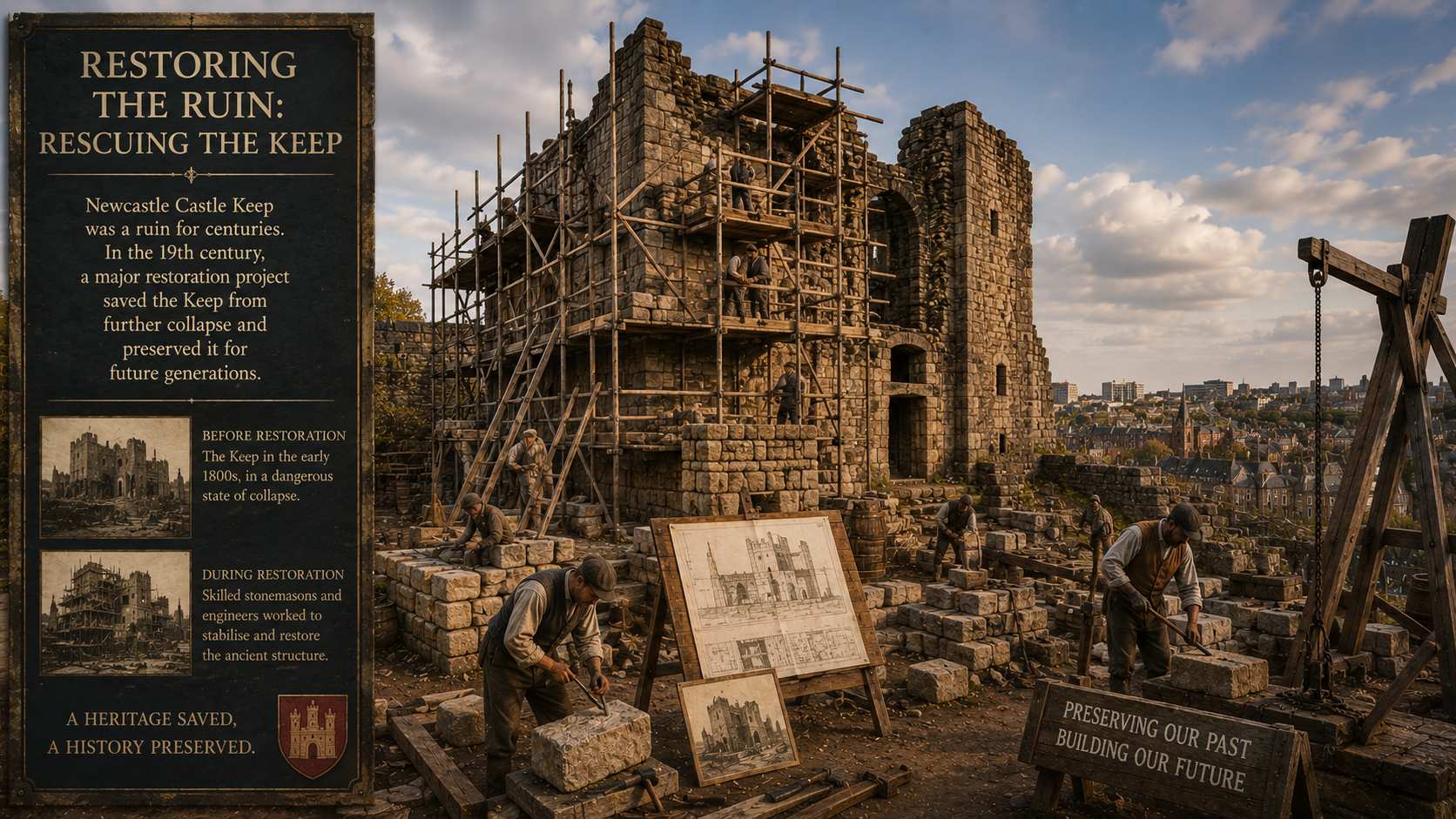
The imposing, largely intact fortress visitors encounter at Newcastle Castle Keep today bears only partial resemblance to the building's condition just two centuries ago. For long stretches of its history, the Keep stood roofless, crumbling and genuinely close to complete ruin.
A Long, Slow Decline
Newcastle Castle's decline unfolded gradually across several centuries rather than through any single dramatic event. As the castle's original military significance faded, first with the town wall's construction superseding it as the primary defensive structure, and later as the broader Anglo-Scottish border wars that had originally justified such substantial fortification gradually subsided, successive generations invested progressively less in the Keep's ongoing maintenance.
By the early eighteenth century, that accumulated neglect had produced genuinely serious deterioration. Historical accounts describe the Keep by this period as roofless, with its internal floors largely collapsed, a far cry from the substantial, weatherproof royal fortress Henry II's engineers had originally completed in 1177. The building's practical uses during this period of decline reflect just how far its status had fallen: at various points, parts of the structure served as an ice house, a currier's leather-working workshop, and even, according to some records, briefly as a beer cellar for a nearby public house.
Georgian Intervention
The Keep's fortunes began to improve, at least modestly, during the early nineteenth century, when Newcastle's Town Corporation undertook restoration work between approximately 1810 and 1812, part of the same wider building programme that also saw the old Moot Hall demolished and replaced with a grander courthouse nearby. This Georgian-era intervention gave the Keep its current flat roof and distinctive corner turrets, practical repairs that, while not attempting to precisely recreate the building's original twelfth-century appearance, at least arrested its physical decline and rendered it weatherproof once again.
That Georgian restoration, though modest by later Victorian conservation standards, represented a genuinely important turning point, the first significant organised effort to actually preserve rather than simply neglect or actively repurpose the ageing medieval structure.
A Second, More Serious Rescue
The Keep's more significant rescue came later in the nineteenth century, directly connected to the Society of Antiquaries' successful 1847 campaign against railway-driven demolition and their subsequent 1848 lease of the building. Securing the castle's physical survival was only the first step; the Society then faced the considerably larger practical challenge of actually restoring and maintaining a genuinely ancient, structurally compromised building well suited neither to comfortable habitation nor straightforward Victorian-era public access.
Restoration work carried out under the Society's stewardship through the later nineteenth century gradually transformed the Keep from a barely weatherproof ruin into something closer to a genuine heritage attraction, work that eventually led to the establishment of the Black Gate Museum around 1890 and the wider public interpretation of the site that continues, in evolved form, through to the present day.
Restoration as an Ongoing Process
Newcastle Castle's restoration has never really been a single, completed project with a definitive end point, but rather an ongoing process of maintenance, repair and reinterpretation that has continued across multiple subsequent generations, right through to modern conservation work carried out in recent decades to make the site fully accessible and engaging for contemporary visitors. Each generation of custodians has faced its own version of the same fundamental challenge: keeping a genuinely ancient stone structure structurally sound and publicly accessible, while remaining honest about, rather than concealing, the visible evidence of its long, sometimes difficult history.
A major twenty-first-century restoration project reopened much of the Keep and Black Gate to the public with substantially improved facilities and interpretation, a further chapter in the same ongoing story of rescue and renewal that stretches back through the Society of Antiquaries' Victorian stewardship to the Georgian Corporation's original repairs.
That the Keep stands today as one of Newcastle's most visited heritage attractions, rather than a forgotten, roofless ruin, represents the accumulated result of Georgian practical repairs, Victorian antiquarian dedication, and considerable subsequent conservation investment, each phase building on the last to bring a genuinely endangered medieval fortress back from the brink of total loss.
