
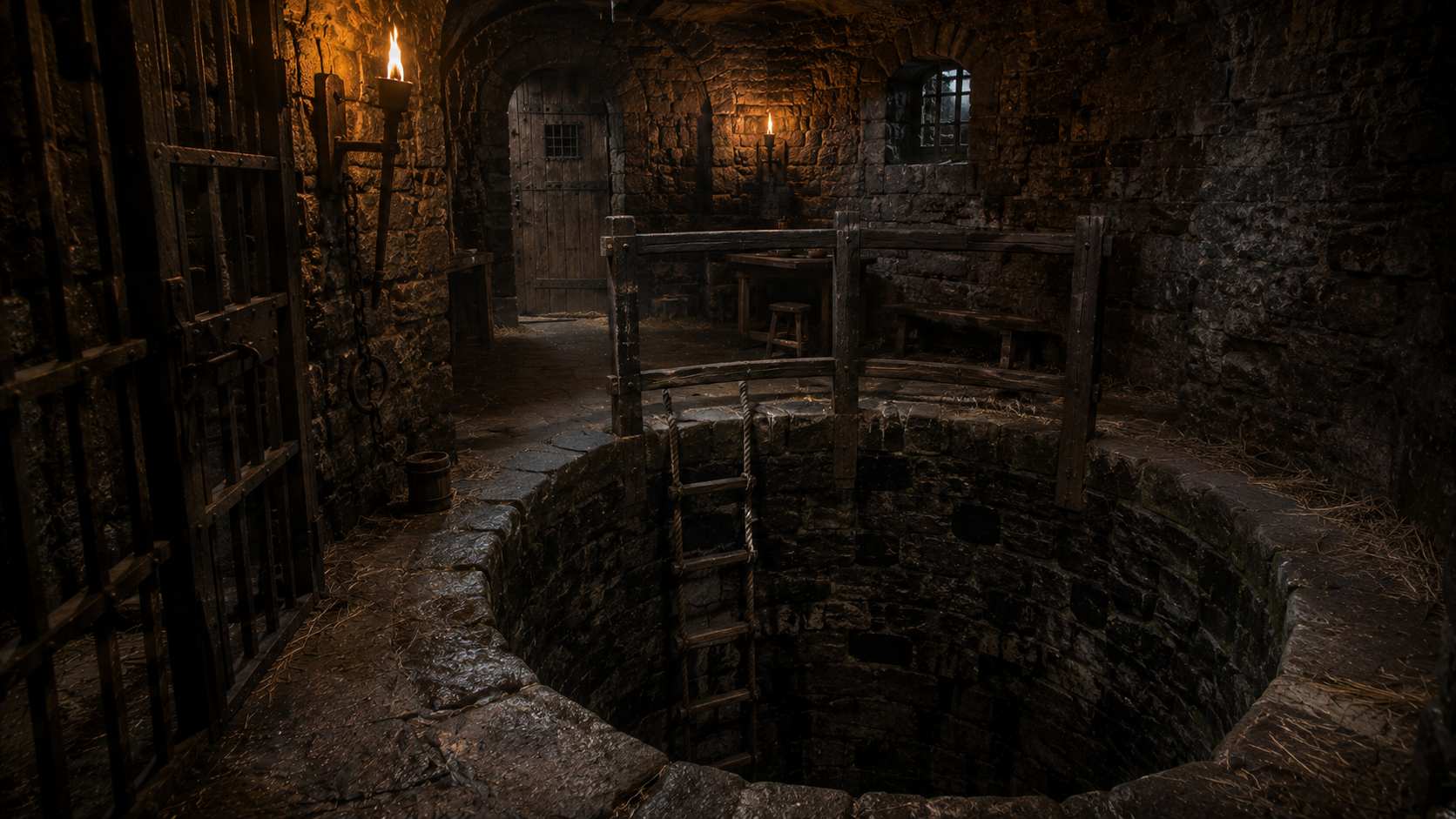
Some medieval prisons at least had the decency to include a door. The Heron Pit, built beneath Newcastle Castle by one of the most corrupt officials in the city's history, had none, only a single trapdoor in the roof through which the unfortunate were simply dropped.
An Official Who Terrorised the Region
William Heron served as Sheriff of Northumberland and Keeper of Newcastle Castle from 1246 or 1247 until his death in 1258, a position of genuine local power he used, according to surviving accounts, with breathtaking corruption. The medieval chronicler Matthew Paris described Heron as "a most avaricious man, a hammer of cruelty to the poor, and a persecutor of the religious orders", language remarkably harsh even by the sometimes unforgiving standards of medieval chronicle writing.
Heron's central role required him to collect royal taxes on behalf of Henry III, a responsibility he exploited ruthlessly for personal enrichment. Historians estimate that as much as thirty percent of the taxes he collected ended up in his own coffers rather than the royal treasury, a scale of embezzlement serious enough that Norwegian merchants reportedly refused to trade in Newcastle entirely while Heron remained in office, unwilling to risk dealing with a sheriff of such well-known dishonesty.
An Oubliette Built for £32
To enforce his authority and silence anyone who challenged it, Heron constructed a purpose-built dungeon within the castle's foundations, a deep, square, entirely windowless pit that visitors and historians now generally describe as an oubliette, a prison specifically designed with no means of escape and, in the starkest versions of the design, little intention that prisoners would necessarily survive their confinement. Records suggest Heron spent around £32 constructing the pit, access possible only through a trapdoor set into the floor of the guardroom above.
Conditions inside were genuinely horrific by any standard. Historians estimate the pit could hold as many as forty people simultaneously, crammed into a confined stone chamber with no natural light, competing for whatever scraps of food and water guards above chose to lower down to them. Prisoners held in the pit could reportedly hear the guards eating and talking in the room directly above their heads, a particularly cruel detail given none of that food was ever destined for them.
A Name That Outlived Its Creator
Heron died in 1258, leaving behind a debt of some £1,200 to be inherited by his son, a considerable sum against an annual land income of only £37, evidence that whatever wealth Heron had extracted through corruption had not translated into lasting family fortune. His name, however, survived considerably longer than his money, permanently attached to the pit he had built, a piece of dark local memory that outlasted him by many centuries.
Surviving records document at least one specific case connected to the pit's use: in 1301, two local men accused of killing a Scottish man were held in the gaol above the pit while awaiting sentencing for what was, in principle, a capital crime, reportedly terrified of being thrown into its depths. They were ultimately pardoned, since their victim was found to be a Scot and therefore, under the period's harsh wartime logic, considered an enemy of the crown rather than deserving full legal protection.
A Grim Landmark Still Visible Today
The Heron Pit remains visible today, open to the air within Newcastle Castle's grounds near the Black Gate, its stark, ashlar-lined depths still giving visitors a genuinely visceral sense of the conditions medieval prisoners once endured here. Now a Grade I listed and scheduled ancient monument, the pit stands as one of the castle's most evocative surviving features, a physical reminder that medieval justice, particularly under officials as corrupt as William Heron, could be brutally, deliberately cruel.
Archaeological excavation of the area around the pit during the 1970s uncovered further evidence of the site's later use, including a separate seventeenth-century pit associated with the castle's Civil War defences, a reminder that this small corner of the castle continued serving grim, security-related purposes for centuries after Heron himself had died.
