
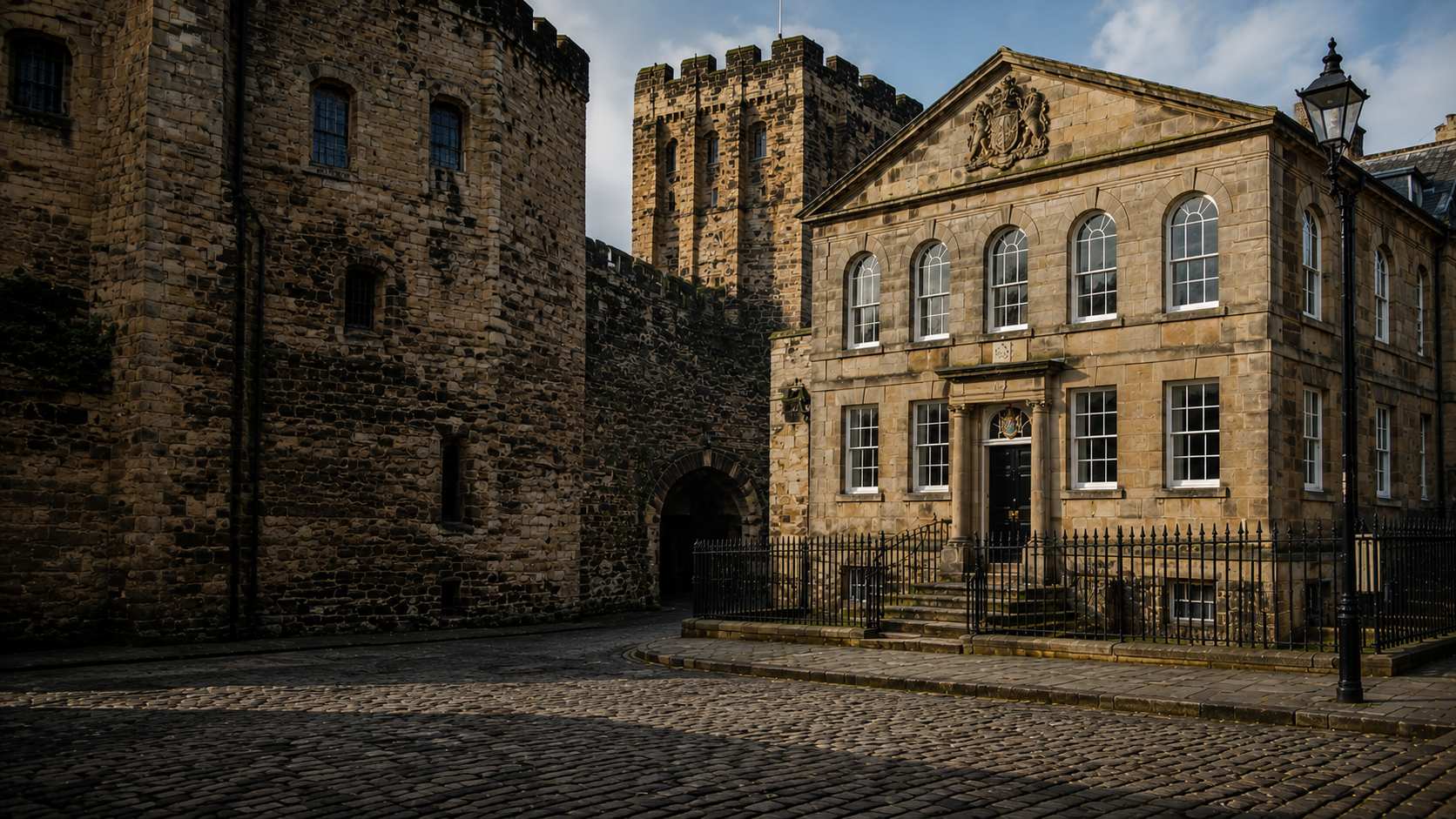
Not every historic building within Castle Garth survived into the modern era, even among those that were not lost to the Victorian railway. Newcastle's original Moot Hall met a rather different fate: deliberately demolished by the town's own authorities to make way for something they considered grander.
A Building for Making Judgements
The term "moot hall" refers to a building traditionally used for civic assemblies and, particularly, judicial proceedings, moot originally meaning a formal meeting or assembly under Anglo-Saxon and medieval English legal tradition. Newcastle's own Moot Hall, standing within Castle Garth alongside the Keep and Black Gate, served precisely this function, a dedicated venue for the town's formal legal and administrative business, distinct from the castle's own judicial functions carried out within the Great Hall.
That distinction between separate civic and castle-based judicial venues reflects the layered, sometimes overlapping administrative structures that governed medieval and early modern English towns, different courts and different authorities, royal, civic, and county-level, each requiring their own dedicated meeting and hearing spaces within the same general precinct.
Demolished for Something Grander
Newcastle's Town Corporation undertook a significant reconstruction programme within Castle Garth between roughly 1810 and 1812, a project that included demolishing the existing Moot Hall entirely to clear space for an ambitious new courthouse. This was, in its own smaller way, a similar pattern to what would later befall much of the wider Castle Garth precinct during the 1840s railway construction: older, historically significant buildings cleared to make way for what contemporary authorities considered necessary progress.
The same building programme also gave the Castle Keep itself its current flat roof and distinctive corner turrets, Georgian additions that, while not part of Henry II's original twelfth-century design, have themselves become such a familiar part of the Keep's silhouette that most modern visitors assume them to be genuinely medieval rather than a comparatively recent restoration-era addition.
A Successor That Still Stands
The courthouse that replaced the old Moot Hall survives today, now serving as Northumberland's County Hall, a building that has itself passed through various subsequent uses and identities, including a period operating as the Vermont Hotel, while retaining its original Georgian architectural character. That continuity, a purpose-built legal and administrative building on this same spot, persisting in one form or another from the early nineteenth century through to the present day, maintains an unbroken thread of civic function even though the specific structure occupying the site has changed entirely.
Unlike the castle's other losses, the demolished curtain wall sections and lost Castle Garth housing that fell victim to Victorian railway construction, the Moot Hall's disappearance reflects a rather different kind of change: not infrastructure-driven demolition imposed from outside, but a deliberate civic decision by Newcastle's own authorities to replace an ageing building with what they judged a more suitable, more impressive successor.
Layers of Lost and Surviving History
The story of the Moot Hall's replacement adds a further layer to Castle Garth's already complicated history of loss and survival, a precinct where different buildings met entirely different fates for entirely different reasons across different centuries: some lost to deliberate civic redevelopment, others to Victorian railway expansion, and a determined few, the Keep and Black Gate chief among them, saved through organised heritage campaigning that could easily have failed.
A Pattern Repeated Across the Precinct
What makes the Moot Hall's fate particularly instructive is how it differs from the castle's other, better-known losses. Where the curtain wall and much of the surrounding housing fell to external infrastructure pressure during the 1840s, the Moot Hall was deliberately chosen for replacement by Newcastle's own civic authorities a full generation earlier, evidence that Castle Garth's built environment was never static, but subject to continuous, often competing pressures for change from multiple different directions across successive centuries.
Understanding Castle Garth today means understanding this layered pattern of loss and survival, recognising that even structures which no longer physically exist, like the original Moot Hall, still shape the precinct's current appearance through the buildings and spaces that eventually replaced them.
