
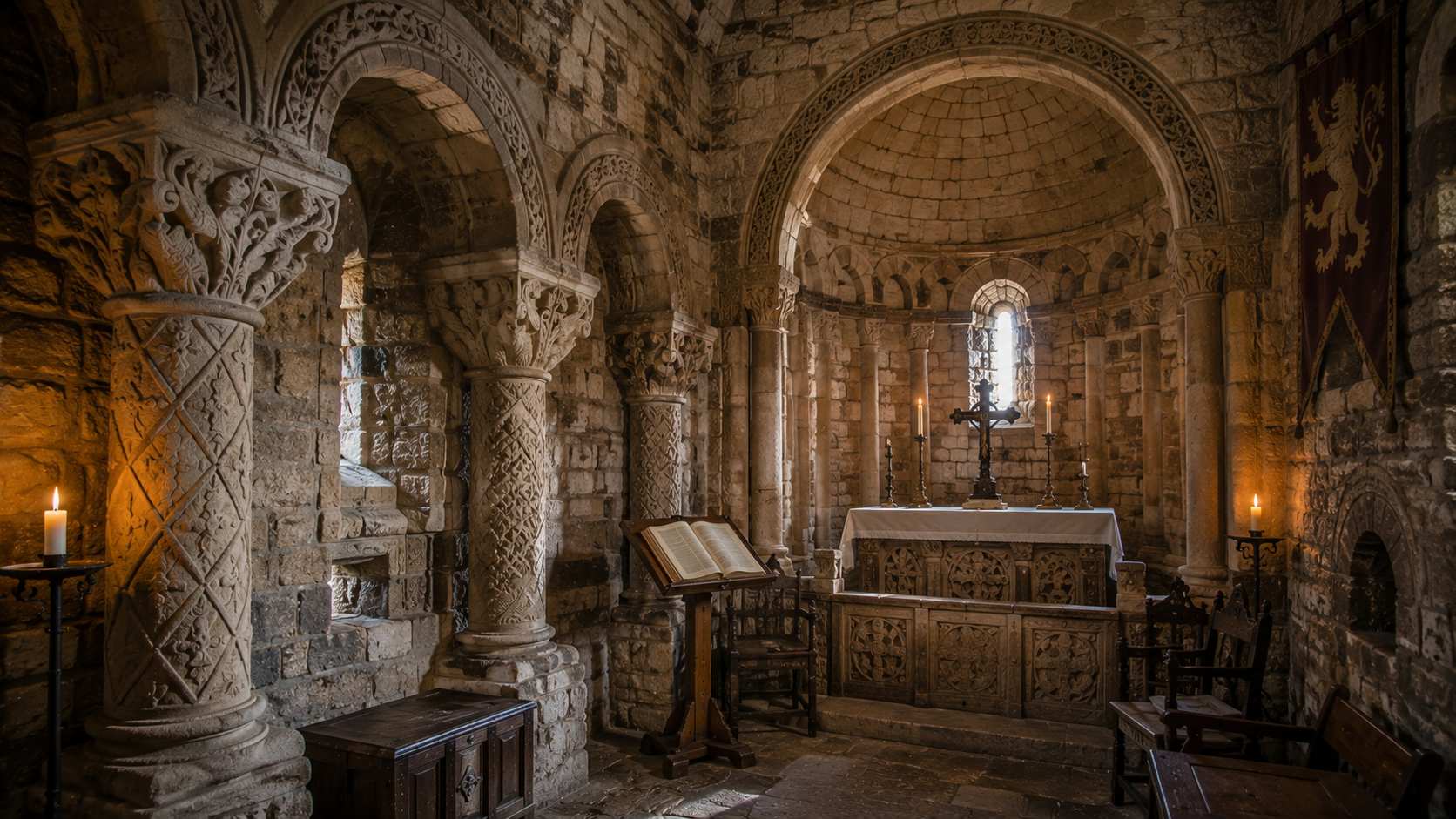
Tucked within the working military machinery of Newcastle Castle Keep, a small chapel offers something visitors might not expect from a fortress built primarily for war: genuinely exquisite decorative stonework, ranked among the finest surviving examples of Norman carving anywhere in England.
Faith Within a Fortress
Medieval castles were never purely military structures; they functioned as complete administrative and domestic complexes, and religious observance formed an essential part of that wider function. Newcastle Castle Keep's Royal Chapel, built as part of Henry II's original stone keep between 1172 and 1177, provided a formal place of worship for the castle's most important residents and visitors, distinct from a separate, more modest chapel elsewhere in the grounds intended for the ordinary garrison's use.
That distinction between a grander Royal Chapel and a simpler garrison chapel reflects the castle's own internal social hierarchy, religious space, like domestic and administrative space, carefully allocated according to rank and status even within the confined footprint of a single fortress.
A Masterpiece in Stone
The Royal Chapel's surviving decorative carving represents genuinely exceptional Norman craftsmanship, intricate stonework that historians and architectural specialists regularly cite among the very best surviving examples of this particular decorative style anywhere in the country. That such refined, deliberately beautiful carving exists within a structure built primarily for defence speaks to how thoroughly Norman elite culture integrated genuine artistic ambition into even their most practical, fortified buildings.
The chapel's craftsmen worked under the same master mason, Maurice, credited with the Keep's overall design, a figure who also worked on Dover Castle, one of England's other great Norman royal fortresses. That shared authorship connects Newcastle's chapel directly to the very highest level of royal architectural patronage available in late twelfth-century England, work commissioned by, and built to satisfy, the standards of the crown itself.
Cracks in the Stone
Nearly nine centuries of continuous existence have inevitably left their mark on the chapel's fabric. A visible structural crack runs in a distinctive zigzag pattern above one of the chapel's stone archways, a stark reminder of the sheer physical weight the structure's stonework has borne, and continues to bear, across its long history. Rather than being hidden or disguised, such cracks are generally left visible within the restored castle today, an honest acknowledgement of the building's genuine age rather than an attempt to present a falsely pristine appearance.
That approach to restoration, preserving genuine signs of age and stress within the structure rather than concealing them entirely, reflects broader modern conservation philosophy, which generally favours honest, legible history over an artificially perfected finish that might otherwise misrepresent just how long, and how much weight, a structure like this has genuinely endured.
A Quiet Contrast to the Castle's Grimmer Spaces
The Royal Chapel offers a markedly different atmosphere from some of the castle's other surviving spaces, the grim, windowless Heron Pit dungeon a short distance away chief among them. Where the pit speaks to the castle's darker history of medieval justice and confinement, the chapel represents its more refined, ceremonial dimension, a space designed for quiet worship rather than punishment, decorated with genuine artistic care rather than built purely for grim practical function.
A Second, Simpler Chapel
Alongside the ornate Royal Chapel, the wider castle grounds once held a second, considerably more modest chapel intended for use by the ordinary garrison rather than the castle's royal and noble visitors. That distinction between grand and garrison chapels illustrates how thoroughly medieval castle life was organised around rank, with even something as fundamental as religious observance carefully separated according to a visitor's or resident's social standing within the fortress's internal hierarchy.
Visitors moving between these two extremes, the chapel's careful beauty and the pit's stark cruelty, within a single short walk through the Keep, encounter something genuinely representative of medieval castle life more broadly: an institution that combined refined culture and brutal power within the very same walls, sometimes only a few short steps apart from one another.
