
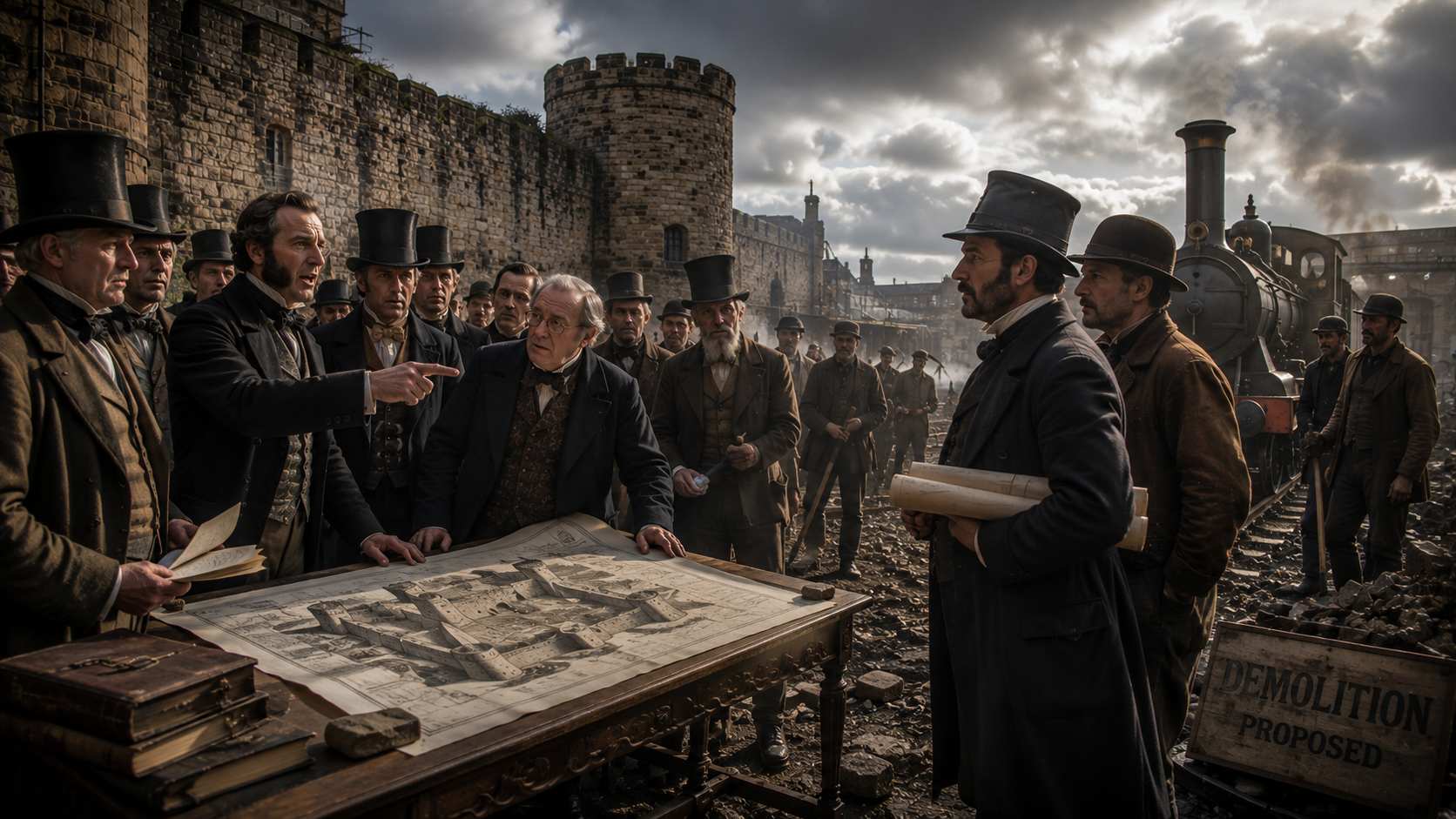
Newcastle Castle exists today largely because a group of local history enthusiasts refused to let Victorian railway engineers demolish it. Their campaign, waged in 1847, stands as one of the earliest and most consequential heritage preservation battles in the entire city's history.
England's Oldest Provincial Antiquarian Society
The Society of Antiquaries of Newcastle upon Tyne was founded in 1813, establishing itself as the oldest provincial antiquarian society anywhere in England, dedicated to promoting deeper understanding and appreciation of the history and archaeology of North East England. By the 1840s, the society had built up more than three decades of institutional experience and genuine local standing, resources it would soon need to draw on directly when Newcastle Castle itself came under serious threat.
That threat arrived in the form of Victorian Britain's railway boom, which by the mid-1840s had reached Newcastle with plans for a major new route requiring substantial new infrastructure directly through the heart of the historic city centre, including, according to the original proposals, the site occupied by the medieval castle itself.
A Relic Considered Expendable
Attitudes towards Newcastle Castle's own significance were, by 1847, considerably less reverent than modern heritage sensibilities might assume. Some involved in planning the new railway reportedly viewed the ageing medieval fortress as little more than a "barbarous relic of antiquity", an obstacle to legitimate modern progress rather than a structure genuinely worth preserving at any meaningful cost or inconvenience to the new railway's construction.
That dismissive attitude reflected a genuinely common Victorian tension between celebrating historical heritage in the abstract and being willing to actually sacrifice practical convenience or commercial advantage to preserve it in specific, concrete cases, a tension that played out repeatedly across nineteenth-century Britain as railway expansion and urban redevelopment regularly threatened historic buildings that later generations would come to consider genuinely irreplaceable.
A Campaign That Actually Worked
The Society of Antiquaries mounted determined, sustained opposition to the demolition proposals, campaigning specifically against plans that would have destroyed both the Norman castle itself and its surrounding Garth precinct entirely. That campaign succeeded, forcing the railway's engineers to substantially redesign their planned route, building around the castle's core structures rather than through them, even though the wider Castle Garth precinct and much of the original curtain wall were still ultimately lost to the new viaduct's construction.
Securing that partial victory required more than simply winning the argument; it required the Society to take on genuine practical responsibility for the castle's future. In 1848, the year following their successful campaign, the Antiquaries were granted a long lease on the building at a nominal rent, formally transferring meaningful practical stewardship of the castle to the very organisation that had just fought to save it from destruction.
Celebrating a Hard-Won Victory
The Society marked their new acquisition with genuine ceremony, holding a Grand Antiquarian Banquet within the castle's own Great Hall, the same substantial medieval chamber that had once hosted royal feasts and formal Sheriff's court proceedings centuries earlier. That celebratory banquet, held within the very structure the Society had just spent months fighting to preserve, offered a fitting, symbolically resonant conclusion to their successful campaign.
A Legacy of Ongoing Stewardship
The Society of Antiquaries' connection to Newcastle Castle has persisted essentially unbroken since that 1848 lease, the organisation maintaining a continued institutional presence at the site, including within the restored Black Gate, right through to the present day, where it remains formally involved in the castle's ongoing management as part of the wider Heart of the City Partnership overseeing the site's preservation and public access.
That continuity, one institution maintaining a genuine working relationship with a single historic site across nearly two centuries, is itself a rare achievement, a reminder that effective heritage preservation typically depends less on any single dramatic rescue than on the kind of sustained, patient institutional commitment the Society has provided ever since 1848.
Without that 1847 campaign, waged by a group of committed local historians against the full commercial momentum of the Victorian railway boom, Newcastle Castle's Keep and Black Gate might very plausibly not exist at all today, a sobering reminder of just how narrowly some of the city's most treasured historic landmarks actually survived into the modern era.
