
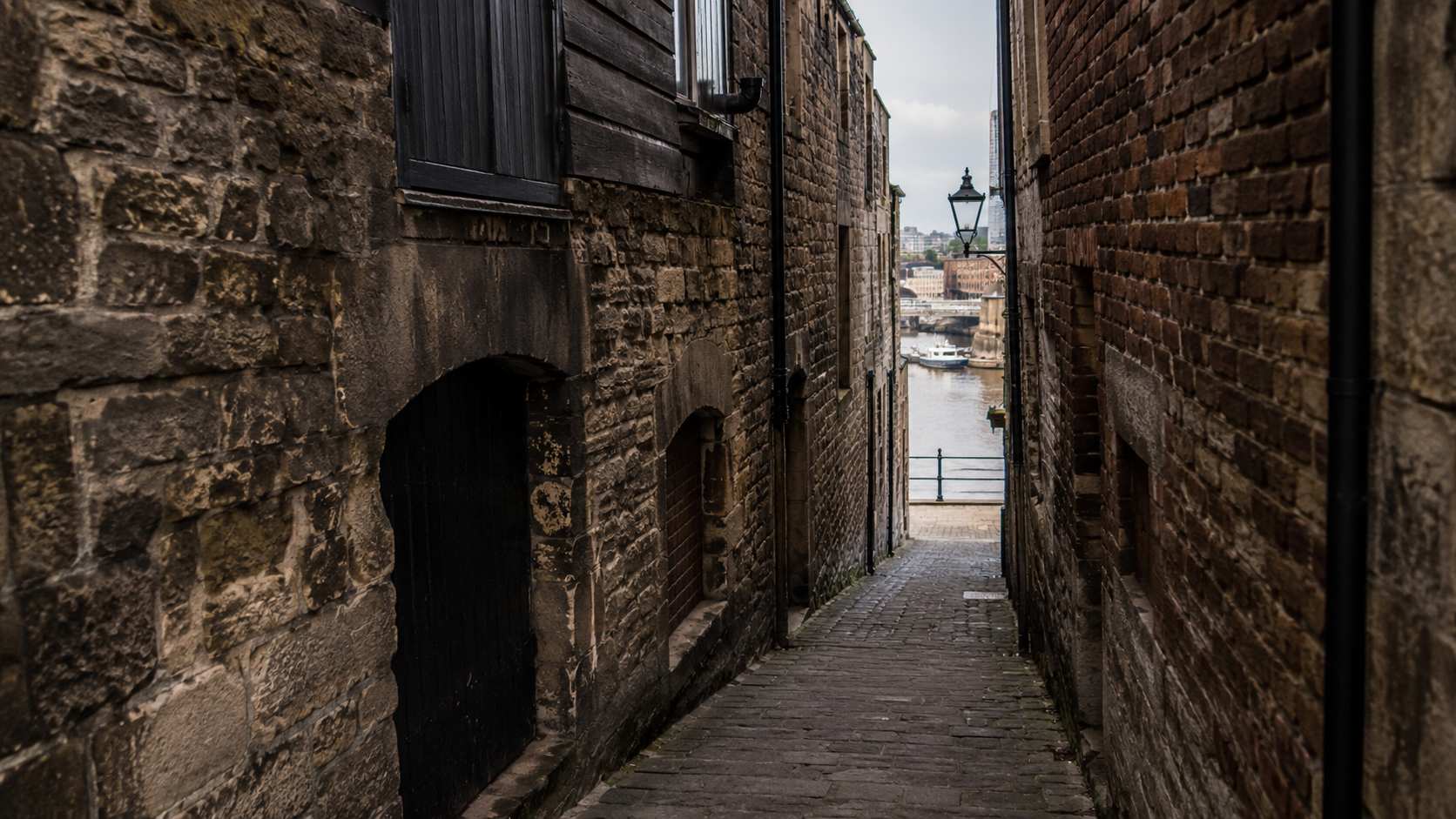
Newcastle once possessed a genuinely distinctive urban feature that most visitors today would walk past without noticing: chares, narrow medieval alleyways threading between the Quayside's larger streets, most of which have long since disappeared beneath later development.
An Anglo-Saxon Word for a Sharp Turn
The word "chare" derives from an Anglo-Saxon term meaning a ninety-degree turn, or bend, an appropriately descriptive name for these narrow passageways, which frequently projected from neighbouring streets at exactly this kind of sharp angle rather than running in straightforward parallel lines. That etymology reflects the genuinely organic, unplanned way these alleys developed over centuries, evolving gradually according to practical need rather than following any deliberate, geometrically regular town planning scheme.
Newcastle's chares had genuinely ancient origins connected directly to the Quayside's own medieval development. As the river's edge was gradually built out through the accumulation of wooden jetties, with the gaps between them progressively filled with rubble and built upon, the resulting new riverside land created the Quayside's characteristic layout, and the old wooden jetties themselves evolved into the narrow alleyways that would eventually become known as chares.
A Once-Extensive Network
At the height of their extent, Newcastle's chares formed a genuinely dense network threading through the Quayside district, providing pedestrian routes between the main riverside thoroughfares and the streets running further back from the water's edge. That density reflected the area's medieval and early modern urban character more broadly, buildings packed tightly together with relatively little formal planning, requiring an equally dense network of narrow connecting passages to allow people and goods to actually move through the resulting maze of closely spaced structures.
Each chare typically carried its own individual name, often reflecting a specific trade, landmark or property owner once associated with that particular passage, a naming pattern that, where it survives, still offers modern researchers valuable clues about the specific commercial and social activities once concentrated along each individual alley.
Gradually Lost to Redevelopment
Newcastle's chares have suffered severe attrition across the centuries since their medieval heyday, successive waves of redevelopment, Victorian street widening and modernisation, twentieth-century clearance, and the more recent comprehensive regeneration of the wider Quayside area all claiming individual chares one by one, until only a small fraction of the original extensive network survives today. That loss reflects a common pattern affecting comparable narrow medieval streetscapes across many historic British cities, urban planning philosophies across different eras generally favouring wider, more easily navigable modern streets over the narrow, characterful but practically inconvenient alleys medieval towns had originally developed.
Only a small number of Newcastle's original chares remain genuinely walkable today, narrow survivors offering a rare, tangible connection to the Quayside's much older medieval street pattern amid a district otherwise substantially rebuilt and reorganised across the intervening centuries.
A Vanishing Pattern Worth Remembering
Understanding the chares adds a genuinely important dimension to appreciating the Quayside's full historical character, a reminder that beneath the area's more celebrated grand merchant houses and civic buildings lay an equally significant, if considerably less glamorous, network of narrow working passages that once carried the everyday foot traffic sustaining the district's busy commercial life. Their continued gradual disappearance across recent decades makes the small number of surviving chares genuinely precious as tangible physical evidence of exactly how organically, and how densely, medieval Newcastle's riverside quarter actually developed, long before any more formal, spacious modern street planning ever reached this particular corner of the city.
Walking the handful of surviving chares today, narrow, shadowed passages squeezed between much larger surrounding buildings, offers a genuinely rare physical sensation unavailable almost anywhere else in modern Newcastle, a direct, tangible encounter with the actual physical scale and density of the medieval town that once stood on this exact same ground, centuries before any wider, more spacious, considerably more modern street was ever actually cut directly through this same historic patch of riverside ground at all. Few corners of Newcastle offer quite so intimate a physical connection to the medieval town.
